
← All marine life
Weedy Seadragon
Group IUCN · Vulnerable (VU)

Weedy Seadragon

Phyllopteryx taeniolatus, (Lacepède, 1804)

marine

About Weedy Seadragon

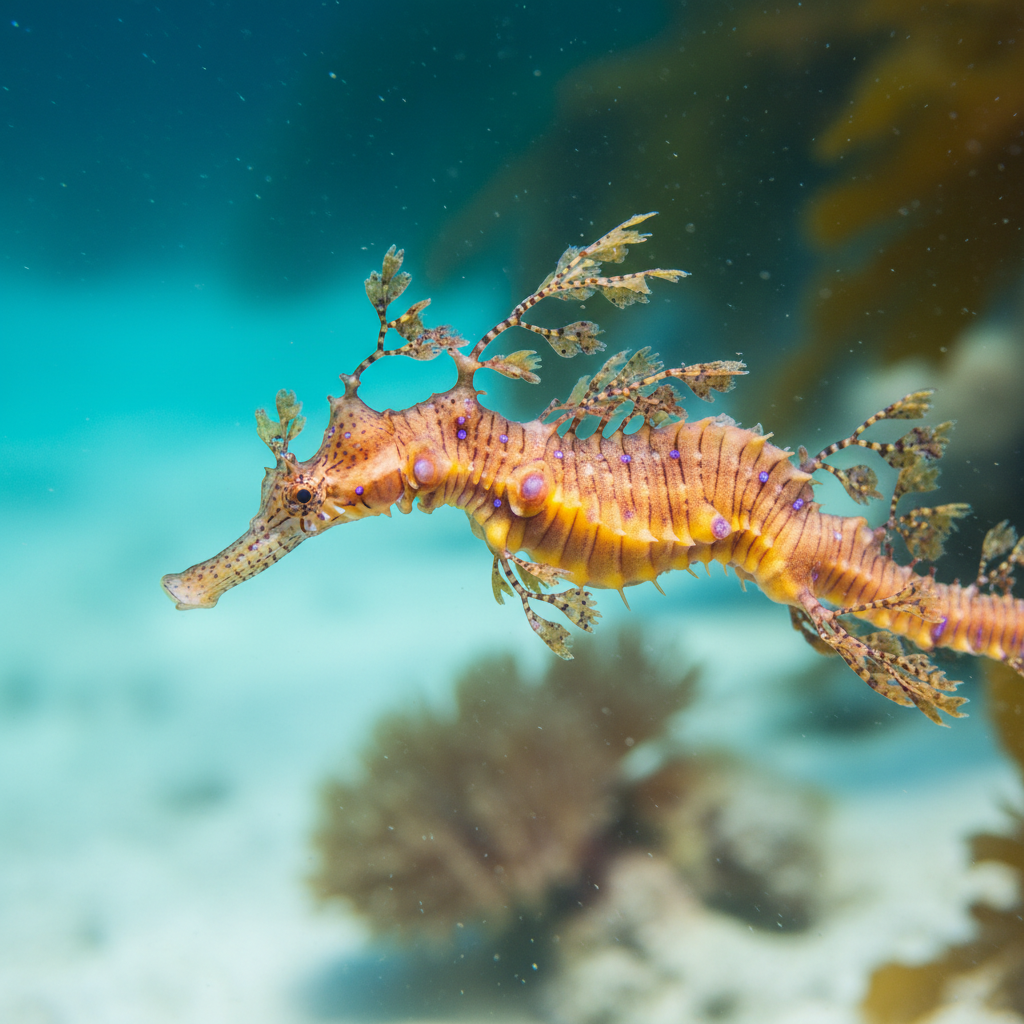
The common seadragon or weedy seadragon (Phyllopteryx taeniolatus) is a marine fish of the order Syngnathiformes, which also includes the similar pipefishes, seahorses, and trumpetfishes among other species. Adult common seadragons are a reddish colour, with yellow and purple striped markings; they have small, leaf-like appendages that resemble kelp or seaweed fronds, providing camouflage, as well as a number of short spines for protection. As with seahorses and the other syngnathids, the seadragon has a similarly tubular snout and a fused, toothless jaw into which it captures small invertebrate prey at lightning speed. Males have narrower bodies and are darker than females. Seadragons have a long dorsal fin along the back and small pectoral fins on either side of the neck, which provide balance. Weedy seadragons can reach 45 cm (18 in) in length.

The common seadragon is the marine emblem of the Australian state of Victoria.

Habitat

The common seadragon is endemic to Australian and insular coastal waters of the eastern Indian Ocean northern Southern Ocean and the southwestern Pacific Ocean. It can generally be found along the entire southern coastline of the Australian continent, including Tasmania and other offshore islands. It can be observed regularly from around Port Stephens, New South Wales to Geraldton, Western Australia, as well as off the coast of South Australia and the Great Australian Bight.

The common seadragon inhabits coastal waters down around 10 m (33 ft) to 30 m (98 ft) deep. It is associated with rocky reefs, seaweed beds, seagrass meadows and structures colonised by seaweed.

Humans & conservation

The common seadragon is classified as Vulnerable (VU) on the IUCN Red List. While the common seadragon is a desired species in the international aquarium trade, the volume of wild-caught individuals is small and therefore not currently a major threat. Instead, habitat loss and degradation due to human activities and pollution threaten common seadragons most.

The loss of suitable seagrass beds and loss of canopy seaweed from inshore rock reefs, coupled with natural history traits that make them poor dispersers, put the future of seadragon populations at risk. This species is not at present a victim of bycatch or a target of trade in traditional Chinese medicine, two activities which are currently a threat to many related seahorse and pipefish populations.

Where to see it

No dive sites list Weedy Seadragon yet. Explore the map to find sites near you.