
← All marine life
Viper Moray
Species IUCN · Least Concern (LC)

Viper Moray

Enchelynassa canina, (Quoy & Gaimard, 1824)

marine

About Viper Moray

The viper moray (Enchelynassa canina) is a species of saltwater eel, the only member of the genus Enchelynassa of the family Muraenidae. It is found in the Indo-Pacific oceans.

Appearance

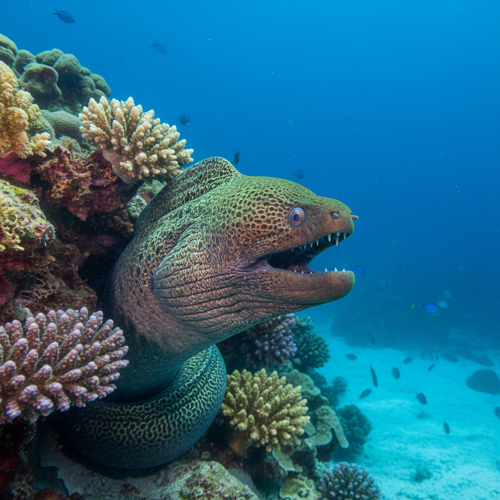
The viper moray can grow up to 250 cm. Recognized for its elongated body and sharp, fang-like teeth, this eel is a formidable predator in coral reef ecosystems. It has a slender, elongated body with a dark brown or grayish coloration. One of its most distinctive features is its set of large, pointed teeth. The body is long and sturdy, with a tail shorter than the combined length of the head and trunk. It has a wide mouth with curved jaws, and its sharp teeth remain visible even when the mouth is closed. The large, oval-shaped rear nostrils are surrounded by a fleshy rim and positioned in front of the eyes. The front nostrils are tubular, each featuring a bilobed fleshy flap. Its teeth are sharp and fang-like, arranged in two rows along the jaws, with two small conical teeth on the vomer at the roof of the mouth. The dorsal fin begins in front of the gill openings.
Habitat

Viper moray eels are widely distributed across the Indo-Pacific region, inhabiting tropical and subtropical marine environments. Its range extends from the eastern coast of Africa, including the Red Sea, to the central and western Pacific Ocean. It can be found in the waters around the coastlines of India, Indonesia, and Australia. The species is also present in Japan, the Philippines, Papua New Guinea, and various Pacific islands, including Hawaii and French Polynesia.

Diet

The viper moray eel is a carnivorous predator that primarily feeds on fish and octopus. Like other moray eels, E. canina possesses a secondary set of jaws known as pharyngeal jaws, which are located in its throat.

Part of

Where to see it

No dive sites list Viper Moray yet. Explore the map to find sites near you.