
← All marine life
Verrill's Two-Spot Octopus
Species IUCN · Least Concern (LC)

Verrill's Two-Spot Octopus

Octopus bimaculatus, A. E. Verrill, 1883

marine

About Verrill's Two-Spot Octopus

Octopus bimaculatus, commonly referred to as Verrill's two-spot octopus, is a similar species to the California two-spot octopus (Octopus bimaculoides), which it is often mistaken for. The two can be distinguished by the difference in the blue and black chain-like pattern of the ocelli. O. bimaculatus hunt and feed on a diverse number of benthic organisms that also reside off the coast of Southern California. Once the octopus reaches sexual maturity, it shortly dies after mating, which is approximately 12–18 months after hatching. Embryonic development tends to be rapid due to this short lifespan of these organisms.

Appearance

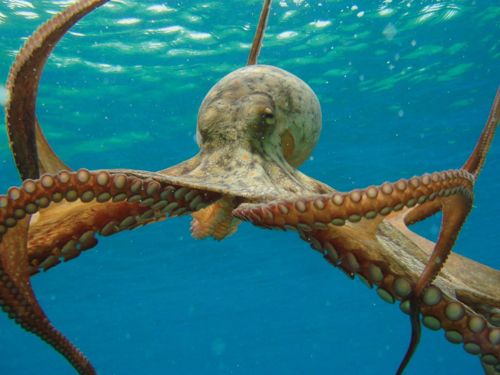
Octopus bimaculatus is typically light brown and spotted in color with a distinctive blue and black false eye, or ocellus, under each eye. The mantle, including the beak and mouth, is located at the center of eight arms. Each of the arms is lined with suckers that are used to help with grasping prey, rocks, and forming shelters.

Similar to other octopus species, O. bimaculatus has skin covered in chromatophores. During the post-larval stage, there are only a few chromatophores and they are called the "founder chromatophores". However, as the octopus matures, more chromatophores form and cover the skin. These chromatophores are pigments that the octopus can expand to create large disc of color that can blend in with the surrounding environment. This is an important behavior that can be used in both defense against predators or to remain hidden from prey before an ambush attack.
Habitat

O. bimaculatus occurs in the northeast Pacific off the coast of Southern California (north to Point Conception) and Baja California (the exact southern limit is unknown) mainly in the intertidal and subtidal regions. These octopus have been observed in kelp forests, bed rock, and rock walls. Typically found on the seafloor, these octopus occupy areas beneath rocks, inside of holes and inside crevices. Juvenile octopus utilize the smaller areas in bedrock, including empty shells found around the bedrock. They frequently use shells for shelter, including the shells of Cypraea spadicea, Astraea undosa, and Hinnites giganteus.

Diet

O. bimaculatus is known to prey on crustaceans, snails, chitons, limpets, and bivalves. Studies have observed the predator-prey interactions between the O. bimaculatus and the Californian scorpionfish (Scorpaena guttata) in aquariums. Findings suggest that the Californian scorpionfish is included in the diet of O. bimaculatus in their natural habitat, specifically juvenile scorpionfish. As juveniles, the octopus tend to prey on smaller benthic, marine invertebrates which include chitons, bivalves, snails, and crabs. Additionally, diet appears to be strongly influenced by location, season, and sex.

Behaviour

O. bimaculatus lives about 12–18 months. Young are planktonic for one to several months before settling on the ground. However, in captivity, O. bimaculatus has been observed to live up to 2 years.

Reproduction

Most matings occur in May and June when water temperatures are rising, and females then lay their eggs between April and August, though they can mate throughout the year.

Mating usually takes between 10 and 60 minutes. During this time, the male extends a modified arm called the hectocotylus, which transfers spermatophores to the female. After the eggs are fertilized, the females lay their eggs in a sheltered area protected by rocks.

Part of

Where to see it

No dive sites list Verrill's Two-Spot Octopus yet. Explore the map to find sites near you.