
← All marine life
Tunicate
Group

Tunicate

Tunicata, Lamarck, 1816

marinebrackishfreshwater

About Tunicate

Tunicates are marine invertebrates belonging to the subphylum Tunicata ( TEW-nih-KAY-tə). This grouping is part of the Chordata, a phylum which includes all animals with dorsal nerve cords and notochords (including vertebrates). The subphylum was at one time called Urochordata, and the term urochordates is still sometimes used for these animals.

Despite their simple appearance and very different adult form, their close relationship to the vertebrates is certain. Both groups are chordates, as evidenced by the fact that during their mobile larval stage, tunicates possess a notochord, a hollow dorsal nerve cord, pharyngeal slits, post-anal tail, and an endostyle. They resemble a tadpole.

Tunicates are the only chordates that have lost their myomeric segmentation, with the possible exception of the seriation of the gill slits. However, doliolids still display segmentation of the muscle bands.

Appearance

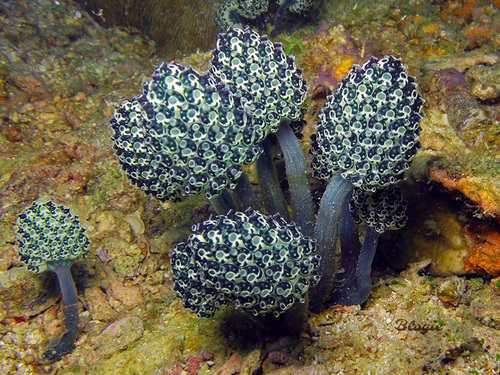
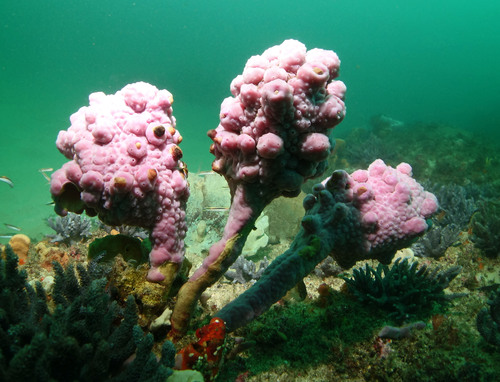
Colonies of tunicates occur in a range of forms, and vary in the degree to which individual organisms, known as zooids, integrate with one another. In the simplest systems, the individual animals are widely separated, but linked together by horizontal connections called stolons, which grow along the seabed. Other species have the zooids growing closer together in a tuft or clustered together and sharing a common base. The most advanced colonies involve the integration of the zooids into a common structure surrounded by the tunic. These may have separate buccal siphons and a single central atrial siphon and may be organized into larger systems, with hundreds of star-shaped units. Often, the zooids in a colony are tiny but very numerous, and the colonies can form large encrusting or mat-like patches.
Diet

Nearly all adult tunicates are suspension feeders (the larval form usually does not feed), capturing planktonic particles by filtering sea water through their bodies. Ascidians are typical in their digestive processes, but other tunicates have similar systems. Water is drawn into the body through the buccal siphon by the action of cilia lining the gill slits. To obtain enough food, an average ascidian needs to process one body-volume of water per second. This is drawn through a net lining the pharynx which is being continuously secreted by the endostyle. The net is made of sticky mucus threads with holes about 0.5 μm in diameter which can trap planktonic particles including bacteria. The net is rolled up on the dorsal side of the pharynx, and it and the trapped particles are drawn into the esophagus. The gut is U-shaped and also ciliated to move the contents along.

Reproduction

Tunicates are almost all hermaphrodites (Oikopleura dioica being a rare exception), and each has a single ovary and testis, either near the gut or on the body wall. All larvaceans are semelparous and have external fertilization, and all thaliaceans have internal fertilization. In solitary ascidians, sperm and eggs are generally shed into the sea and the larvae are planktonic. In colonial ascidians, fertilization is internal; sperm is released into the water and drawn into the atria of other individuals with the incoming water current. Fertilization takes place here and the eggs are brooded through their early developmental stages. Some larval forms appear very much like primitive chordates with a notochord (stiffening rod) and superficially resemble small tadpoles. These swim by undulations of the tail and may have a simple eye, an ocellus, and a balancing organ, a statocyst.

Humans & conservation

Tunicates contain a host of potentially useful chemical compounds, including:

Plitidepsin, a didemnin effective against various types of cancer; as of late January 2021 undergoing Phase III trials as a treatment for COVID-19

Trabectedin, an FDA approved anticancer drug.

Tunicates are able to correct their own cellular abnormalities over a series of generations, and a similar regenerative process may be possible for humans. The mechanisms underlying the phenomenon may lead to insights about the potential of cells and tissues to be reprogrammed and to regenerate compromised human organs.

Species in this group

Where to see it

No dive sites list Tunicate yet. Explore the map to find sites near you.