
← All marine life
Triangle Barnacle
Species

Triangle Barnacle

Balanus trigonus, Darwin, 1854

marine

About Triangle Barnacle

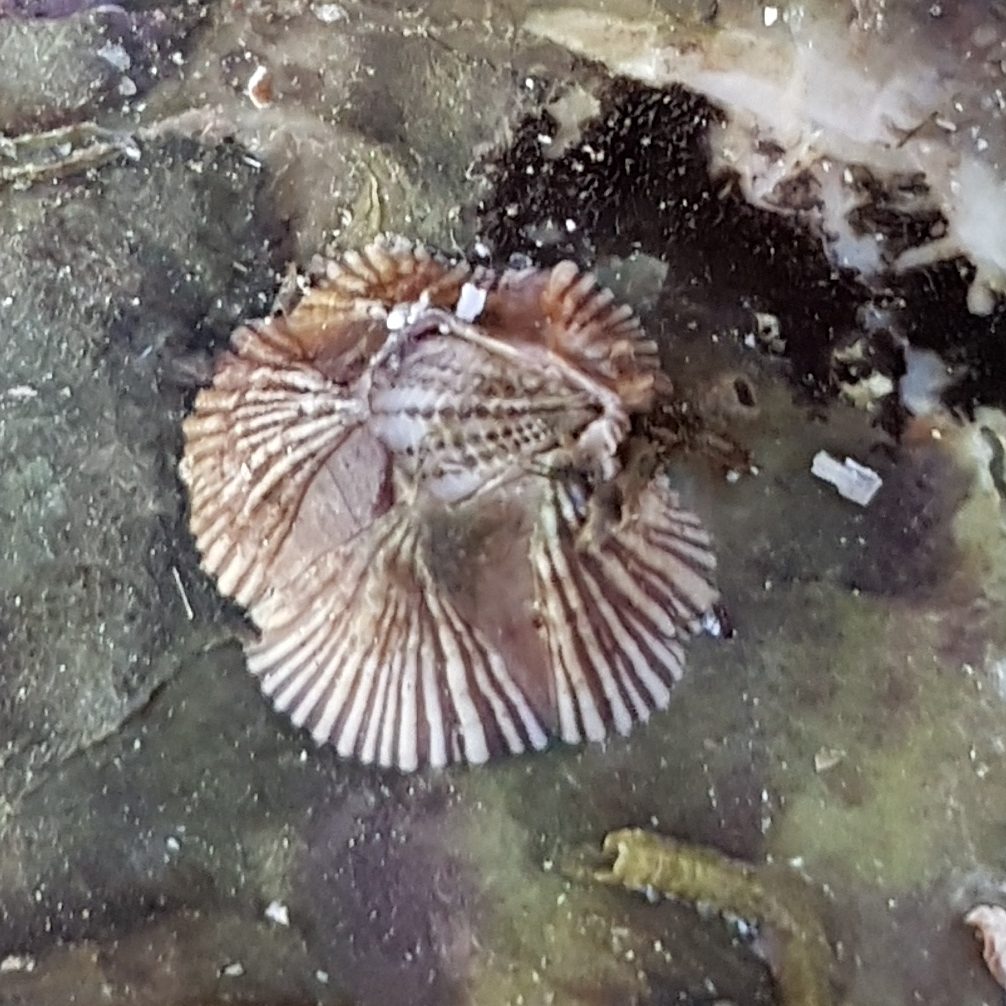
Balanus trigonus, the triangle barnacle, is a species of barnacle in the family Balanidae. They are steep-sided, conical creatures, have six shell plates and are dark pink in colour. Originally found only in the Indo-Pacific and along the eastern Pacific coast, they were likely introduced to the Atlantic Ocean in the 19th century through human activity and now has a global distribution. Usually living on subtidal rocks and shells, they are also foulers of ships and dock infrastructure, and, in areas where they are invasive, may compete with native species for living room. The species was first described in the genus Balanus by Charles Darwin. It has since had its mitochondrial genome sequenced twice, with slightly differing results, leaving its phylogenetic position unsolved.

Appearance

Triangle barnacles are typically around 2 centimetres (0.8 in) across at the base and form a steep-sided, conical shape, growing from 1.3 to 1.9 centimetres (0.5 to 0.7 in) tall. The barnacle shells include a shell wall, comprising plates which are connected by sutures to wrap around to form a circular barrier. In this species, the shell wall is made of six dark pink plates which are covered with white rib-like ridges as well as interior pores. Each plate is made up of a central triangular portion named the parietes, and overlapping side segments known as radii; the latter, in triangle barnacles, are paler than the parietes, being white or pale pink. A flat-shaped and pore-covered calcareous basis forms the bottom of the shell and connects to the ground or material the barnacle is growing on.

Habitat

Triangle barnacles are originally native to the Indian and Pacific oceans, but now have a cosmopolitan distribution. Darwin, in his original description, said the species was "widely distributed and where found seems to be common". He gave the species' range as including New Zealand, Sydney, the island of Java, the East Indian Archipelago, Peru, California, and what he called "West Columbia". Triangle barnacles are also native to the waters around Korea and the south of Japan but its presence in the north Sea of Japan is likely due to human activity. Triangle barnacles are also known from the Persian Gulf and the adjacent Gulf of Oman, around the Indian subcontinent, and along the east coast of Africa. However, all triangle barnacle presence in the Atlantic Ocean is introduced, which was once not believed to be true.

Diet

Triangle barnacles feed on plankton such as diatoms and copepods. The barnacles are able to assimilate and retain large amounts of metals they may get from their diets, such as zinc and cadmium, into their bodies. Concentrations of these metals are often relatively high in barnacles.

Reproduction

Barnacles are sessile as adults but have motile larval stages, first the nauplii, and then the cyprids, which do not eat but attach themselves to a substrate and metamorphosed into adults. The adults reproduce year-round, and individuals only a month old may do so as well. A given barnacle may also produce multiple broods each year.

Where to see it

No dive sites list Triangle Barnacle yet. Explore the map to find sites near you.