
← All marine life
Thornback Ray
Species IUCN · Near Threatened (NT)

Thornback Ray

Raja clavata, Linnaeus, 1758

marine

About Thornback Ray

The thornback ray (Raja clavata), or thornback skate, is a species of ray fish in the family Rajidae.

Appearance

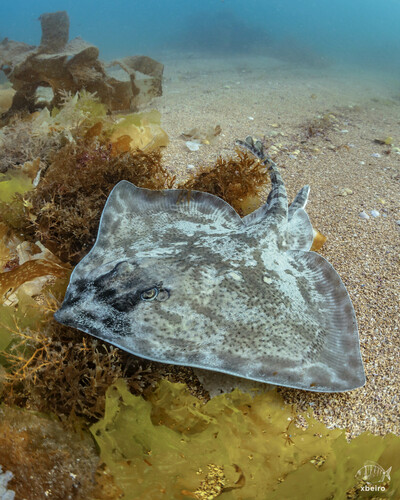
Like all rays, the thornback ray has a flattened body with broad, wing-like pectoral fins. The body is kite-shaped with a long, thorny tail. The back is covered in numerous thorny spines, as is the underside in older females. The upper and lower jaws have between 36-44 rows.

Adult fish can grow to 1 metre (3.3 ft) in length, although most are less than 85 centimetres (33 in). This ray can weigh from 4.5 to 8.75 lb (2 to 4 kg).

Their colours vary from light brown to grey with darker blotches and numerous small darker spots and yellow patches. Sometimes the yellow patches are surrounded by small dark spots. The underside is creamy-white with a greyish margin. When threatened they can appear black.

In sexually mature fish, some of the spines are thickened with button-like bases (known as bucklers). These are particularly well developed on the tails and backs of sexually mature females.
Habitat

The Thornback ray is found in the Atlantic coastal waters of Europe and western Africa. It is also present from South Africa to the southwestern Indian Ocean and in the Mediterranean and Black Seas. It is native possibly as far south as Namibia and South Africa.

Its natural habitats are open large seas and shallow seas. It is sometimes seen trapped in large estuarine pools at low tide.

The thornback ray is probably one of the most common rays encountered by divers.

Reproduction

Thornback rays are an oviparous and polyandrous species. Paired eggs are laid and deposited on shallow sand, mud, pebble or gravel bottoms . Up to 170 egg cases can be laid by a single female in a year, average fecundity around 48–74 eggs. In northwestern Europe, egg cases are laid during spring, and in the Mediterranean during winter and spring. Egg cases are oblong capsules with stiff pointed horns at the corners, each containing one embryo. Capsules are 5.0–9.0 cm long without the horns and 3.4–6.8 cm wide. Egg cases are anchored with an adhesive film.

Embryos feed solely on yolk. Egg cases hatch after about 4–5 months and pups are about 11–13 cm.

Part of

Where to see it

No dive sites list Thornback Ray yet. Explore the map to find sites near you.