
← All marine life
Sydney Octopus
Species IUCN · Least Concern (LC)

Sydney Octopus

Octopus tetricus, A. A. Gould, 1852

marine

About Sydney Octopus

Octopus tetricus, the gloomy octopus, the common Sydney octopus, or the peachy octopus, is a species of octopus from the subtropical waters of eastern Australia and northern New Zealand. O. tetricus belongs to the Octopus vulgaris species group. All species within the O. vulgaris group are similar in morphology, behaviour, and physiology. The English translation of O. tetricus (Latin) is 'the gloomy octopus'. It is a significant species in the fishing industry in Australia. They play an important role in energy flux between trophic levels in the marine environment.

Appearance

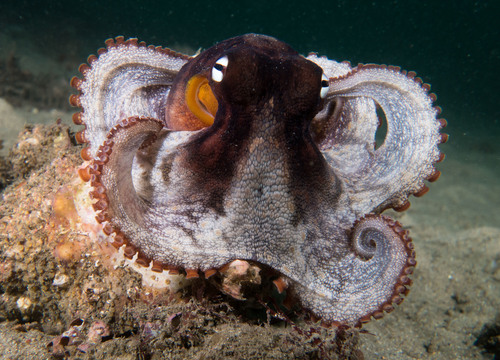
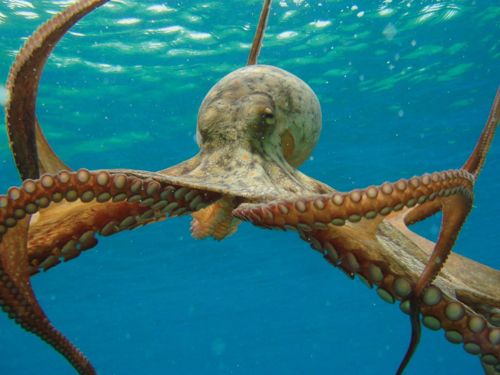
Octopus tetricus is normally coloured grey to mottled brown with rufous arm faces that taper towards the tip. They have orange colouration of arms, funnel, and mantle opening. Their eyes are typically white in colour. The skin is granular, and has many small irregularly shaped patches and large warty structures used to make it appear spiky when the octopus camouflages itself as seaweed. The adults typically have an arm span of 2 metres (6.6 ft) and a mantle length of up to 20 cm (7.9 in). The maximum weight recorded for O. tetricus is 2.6 kg (5.7 lb).
Habitat

O. tetricus was originally discovered in New South Wales and was also found along the eastern Australian coastline. It occurs from Lakes Entrance in Victoria to Moreton Bay in southern Queensland. O. tetricus is distributed in the subtropical seas of eastern Australia and northern New Zealand, including Lord Howe Island. A close relative, Octopus djinda, occurs at similar latitudes in Western Australia, from Shark Bay to Cape Le Grand, and was considered to be conspecific with O. tetricus until 2021.The first sighting of O. tetricus in New Zealand was not until 1997, and has since become one of the most common species of octopus found in New Zealand, alongside Pinnoctopus cordiformis and Macroctopus maorum. O. tetricus populations in New Zealand are found along the North-East coast of the North Island, between the Bay of Plenty and Northland.

Diet

Octopus tetricus is primarily a nocturnal feeder which uses its sharp beak to feed on crustaceans and molluscs, for example sea snails and bivalves. It has also been recorded as being cannibalistic, sometimes preying on smaller individuals and consuming their limbs. Its primary prey is shellfish, such as scallops, and crustaceans, such as lobster, however its diet is heavily influenced by prey availability. They have also been observed eating sea horses on multiple occasions in New South Wales. The metabolism of an octopus is driven by protein, and it is considered a carnivorous species. O. tetricus predation influences hermit and lobster densities and habitat choice, modifying ecosystem dynamics and trophic interactions of various species. O. tetricus return to their den after hunting to consume their prey in safety.

Behaviour

Octopus tetricus occurs in the intertidal zone along rocky shores and seagrass beds and in the ocean at depths of up to 70 m (230 ft). It has been suggested that this species is associated more commonly with rocky reefs during the breeding season, although they frequent areas of the sea bed with soft-sediments for much of their life. O. tetricus alter their habitats by digging out dens and using remains from prey, including but not limited to shells. It is very common for scallop beds to be found in close proximity to the excavated dens. The scallops serve as a food source and their shells are part of the shell beds built. One O. tetricus den in Sydney has been observed being continuously used by different individuals since at least 2009. O. tetricus has been observed shifting and transporting sediment and shells to maintain their dens.

Reproduction

The reproductive cycle of females is tied to seasonal changes, similar to many other species. Females reach maturity around Australia's spring and summer seasons in order to mate and lay eggs. During the mating process the male O. tetricus passes spermatophores to the female in two different ways. The male either wraps his arms and web around the female's mantle or reaches his mating arm from a distance and inserts it into the female's mantle. The males third right arm is the specialised mating arm, and the sperm is moved down a groove on this arm which has a sucker-less tip. Spermatophores are released from the male's "terminal organ", moved by the male's oral suckers, and then the spermatophores are inserted into the female's oviduct.

Humans & conservation

Octopus tetricus may be caught as bycatch in trawl and lobster-pot fisheries and is then sold for both human consumption and for use as bait. The species made up to 43% of total cephalopod fishing catches in 2007, however, it is possible that O. tetricus was sometimes misidentified as Octopus australis. Since 2016, annual catches of the species has increased over 50% to 12.6 tonnes. In 2017, it was said that O. tetricus made up 14% of the total octopus catch. Their catch rates are highest during spring and summer, by which they then drop significantly just as autumn arrives. Historically and through to the present day, the species is a significantly important species in the fishing industry across Australia.

Part of

Where to see it

No dive sites list Sydney Octopus yet. Explore the map to find sites near you.