
← All marine life
Swordfish
Species IUCN · Near Threatened (NT)

Swordfish

Xiphias gladius, Linnaeus, 1758

marine

About Swordfish

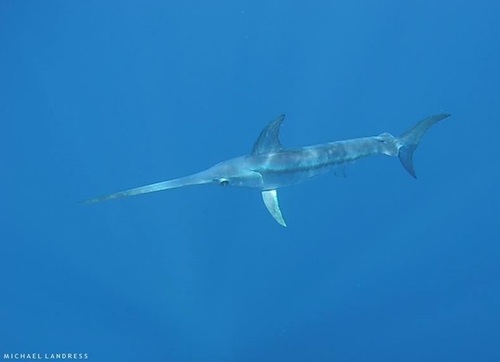
The swordfish (Xiphias gladius), also known as the broadbill in some countries, are large, highly migratory predatory fish characterized by a long, flat, sword-like, pointed bill. They are the sole member of the family Xiphiidae. They are a popular sport fish of the billfish category. Swordfish are elongated, round-bodied, and lose all teeth and scales by adulthood. These fish are found widely in tropical and temperate parts of the Atlantic, Pacific, and Indian Oceans, and can typically be found from near the surface to a depth of 550 m (1,800 ft), and exceptionally up to depths of 2,878 m (9,442 ft). They commonly reach 3 m (10 ft) in length, and the maximum reported is 4.55 m (14 ft 11 in) in length and 650 kg (1,430 lb) in weight.

Appearance

They commonly reach 3 m (10 ft) in length, and the maximum reported is 4.55 m (14 ft 11 in) in length and 682 kg (1,500 lb) in weight. The International Game Fish Association's all-tackle angling record for a swordfish was a 536 kg (1,182 lb) specimen taken off Chile in 1953. Females are larger than males, and Pacific swordfish reach a greater size than northwest Atlantic and Mediterranean swordfish.

They reach maturity at 4–5 years of age, and the maximum age is believed to be at least 9 years. The oldest swordfish found in a recent study were a 16-year-old female and 12-year-old male. Swordfish ages are derived, with difficulty, from annual rings on fin rays rather than otoliths, since their otoliths are small in size.
Diet

Swordfish are classified as oily fish. Many sources, including the United States Food and Drug Administration, warn about potential toxicity from high levels of methylmercury in swordfish. The FDA recommends that young children, pregnant women, and women planning to become pregnant not eat swordfish.

The flesh of some swordfish can acquire an orange tint, reportedly from their diet of shrimp or other prey. Such fish are sold as "pumpkin swordfish" and command a premium over their whitish counterparts.

Swordfish is a particularly popular fish for cooking. Since swordfish are large, the meat is usually sold as steaks, which are often grilled. Swordfish meat is relatively firm and can be cooked in ways that more fragile types of fish cannot (such as over a grill on skewers). The color of the flesh varies by diet, with fish caught on the East Coast of North America often being rosier.

Behaviour

The popular image of the swordfish skewering its prey with its nose is based on little evidence. In a typical environment, swordfish most likely use their noses to slash at prey and inflict weakening injuries. The hypothesis that they may use their noses as spears in a defensive capacity against sharks and other predators is still under review.

Mainly, the swordfish relies on its great speed and agility in the water to catch its prey. It is no doubt among the fastest fish, but the basis for the frequently-quoted speed of 100 km/h (60 mph) is unreliable. Research on related marlin (Istiophorus platypterus) suggest a maximum value of 36 km/h (22 mph) is more likely.

Reproduction

In the North Pacific, batch spawning mainly occurs in water warmer than 24 °C (75 °F) during the spring and summer, and year-round in the equatorial Pacific. In the North Atlantic, spawning is known from the Sargasso Sea, and in water warmer than 23 °C (73 °F) and less than 75 m (246 ft; 41 fathoms) deep. Spawning occurs from November to February in the South Atlantic off southern Brazil. Spawning is year-round in the Caribbean Sea and other warm regions of the west Atlantic.

Large females can carry more eggs than small females, and between 1 million and 29 million eggs have been recorded. The pelagic eggs measure 1.6–1.8 mm (1⁄16–5⁄64 in) in diameter and 2+1⁄2 days after fertilization, the embryonic development occurs. The surface-living and unique-looking larvae are 4 mm (5⁄32 in) long at hatching. The bill is evident when the larvae reach 1 cm (3⁄8 in) in length.

Humans & conservation

Almost 50 species of parasites have been documented in swordfish. In addition to remoras, lampreys, and cookiecutter sharks, this includes a wide range of invertebrates, such as tapeworms, roundworms, Myxozoans and copepods. A comparison of the parasites of swordfish in the Atlantic and in the Mediterranean indicated that some parasites, particularly Anisakis spp. larvae identified by genetic markers, could be used as biological tags and support the existence of a Mediterranean swordfish stock.

Part of

Where to see it

No dive sites list Swordfish yet. Explore the map to find sites near you.