
← All marine life
Surge Wrasse
Species IUCN · Least Concern (LC)

Surge Wrasse

Thalassoma purpureum, (Forsskål, 1775)

marine

About Surge Wrasse

The surge wrasse (Thalassoma purpureum), also known as the green-blocked wrasse, purple wrasse or red and green wrasse, is a species of wrasse native to the southeast Atlantic Ocean through the Indian and Pacific Oceans, where it inhabits reefs and rocky coastlines in areas of heavy wave action at depths from the surface to 10 m (33 ft). This species is of minor importance to local commercial fisheries, is popular as a game fish, and can be found in the aquarium trade.

Appearance

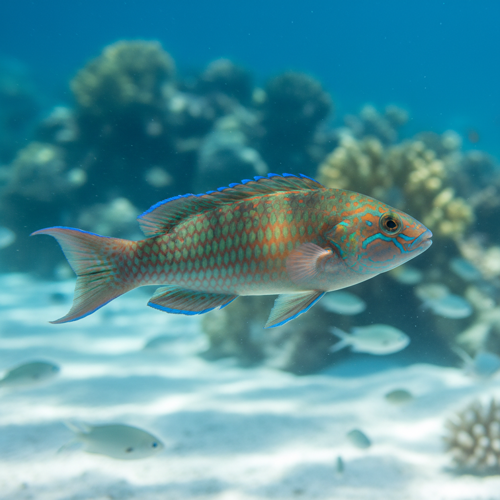
The surge wrasse has 8 spines and 12-14 soft rays in its dorsal fin while the anal fin has 3 spines and 10-12 soft rays. It can grow to 46 cm (18 in) in total length and 1.2 kg (2.6 lb) in weight. It has a rather deep, laterally compressed body and a pair of caniniform teeth in the front of its bottom jaw. This is a colourful species of wrasse in which the females are greenish with their snout marked with a dark red V. The males are greenish-blue in colour with two bright reddish stripes along their flanks and they have a large head with a blunt snout which is greenish-blue with pinkish-purple markings. It is very similar to the ladder wrasse (Thalassoma trilobatum), especially the females, but the surge wrasse has a larger head and no spots on the head.
Habitat

The surge wrasse has a wide Indo-Pacific distribution which extends marginally into the south-eastern Atlantic along the coast of South Africa. Its main distribution in the Indian Ocean extends from the Red Sea south to South Africa east through the Indian Ocean islands and coasts of Asia to the Pacific Ocean where it extends north to Japan and south to Lord Howe Island, Kermadec Islands, and Rapa Islands and east as far as Panama in the eastern Pacific.

Part of

Where to see it

No dive sites list Surge Wrasse yet. Explore the map to find sites near you.