
← All marine life
Sturgeon
Group

Sturgeon

Acipenseridae, Bonaparte, 1831

marinebrackishfreshwater

About Sturgeon

Sturgeon are the 27 species of fish belonging to the family Acipenseridae. The earliest sturgeon fossils date to the Late Cretaceous, and are descended from other, earlier acipenseriform fish, which date back to the Early Jurassic period, some 174 to 201 million years ago. They are one of two living families of the Acipenseriformes alongside paddlefish (Polyodontidae). Sturgeons are native to subtropical, temperate and sub-Arctic rivers, lakes and coastlines of Eurasia and North America. Sturgeons are long-lived, late-maturing fishes with distinctive characteristics, such as a heterocercal caudal fin similar to those of sharks, and an elongated, spindle-like body that is smooth-skinned, scaleless, and armored with five lateral rows of bony plates called scutes.

Several species can grow quite large, typically ranging 2–3.5 m (7–12 ft) in length. The largest sturgeon on record was a beluga female captured in the Volga Delta in 1827, measuring 7.2 m (23 ft 7 in) long and weighing 1,571 kg (3,463 lb). The family is grouped into five genera: Acipenser, Huso, Scaphirhynchus, Sinosturio, and Pseudoscaphirhynchus. One species (S. dabryanus) may be extinct in the wild, and another (P. fedtschenkoi) may be entirely extinct. Beginning in 2011 H. naccarii was presumed extinct in the wild, but in 2022 was downgraded to critically endangered. A Maastrichtian-age fossil found in Morocco shows that they also once lived in northern Africa during the Cretaceous.

Appearance

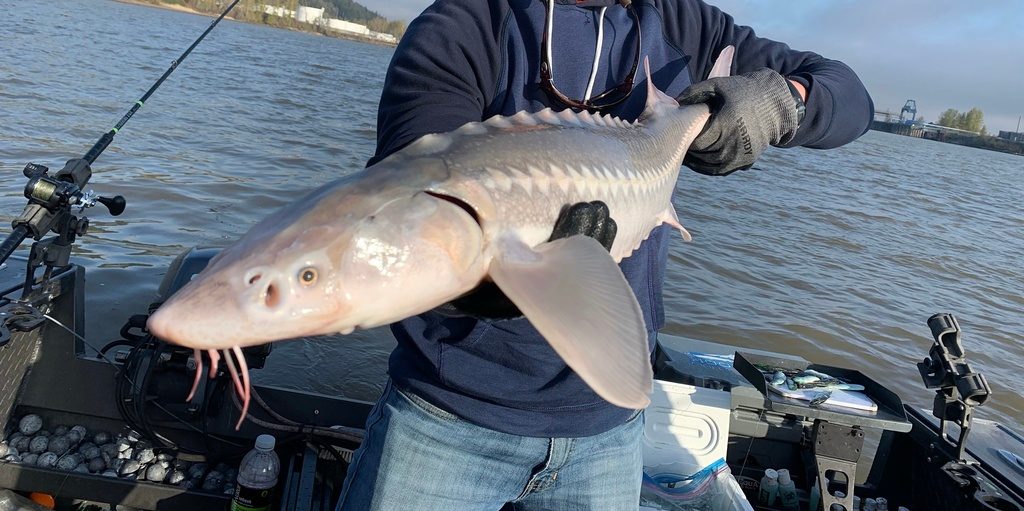
Sturgeons retain several primitive characteristics from the bony fish. Along with other members of the subclass Chondrostei, they are unique among bony fishes because their skeletons are almost entirely cartilaginous. To maintain structure, sturgeons are one of few vertebrates to retain a post-embryonic notochord that acts like a soft spine running through the body. Notably, however, the cartilaginous skeleton is not a primitive character, but a derived one; sturgeon ancestors had bony skeletons. They also lack vertebral centra, and are partially covered with five lateral rows of scutes rather than scales. They also have four barbels—sensory organs that precede their wide, toothless mouths. They navigate their riverine habitats traveling just off the bottom with their barbels dragging along gravel, or murky substrate.

Habitat

Sturgeon range from subtropical to subarctic waters in North America and Eurasia. In North America, they range along the Atlantic Coast from the Gulf of Mexico to Newfoundland, including the Great Lakes and the St. Lawrence, Missouri, and Mississippi Rivers, as well as along the West Coast in major rivers from California and Idaho to British Columbia. They occur along the European Atlantic coast, including the Mediterranean basin, especially in the Adriatic Sea and the rivers of North Italy; in the rivers that flow into the Black, Azov, and Caspian Seas (Danube, Dnepr, Volga, Ural and Don); the north-flowing rivers of Russia that feed the Arctic Ocean (Ob, Yenisei, Lena, Kolyma); in the rivers of Central Asia (Amu Darya and Syr Darya) and Lake Baikal.

Behaviour

Sturgeons are primarily benthic feeders, with a diet of shellfish, crustaceans, and small fish. Exceptionally, the beluga sturgeon, the kaluga sturgeon, the white sturgeon and the pallid sturgeon all feed primarily on other fish as adults. They feed by extending their siphon-like mouths to suck food from the benthos. Having no teeth, they are unable to seize prey, though larger individuals and more predatory species can swallow very large prey items, including whole salmon. Sturgeons feed non-visually. They are believed to use a combination of sensors, including olfactory, tactile, and chemosensory cues detected by the four barbels, and electroreception using their ampullae of Lorenzini.

Reproduction

Sturgeons are long-lived, late-maturing fishes. Their average lifespan is 50 to 60 years, and their first spawn does not occur until they are around 15 to 20 years old. Sturgeons are broadcast spawners, and do not spawn every year because they require specific conditions. Those requirements may or may not be met every year due to varying environmental conditions, such as the proper photoperiod in spring, clear water with shallow rock or gravel substrate, where the eggs can adhere, and proper water temperature and flow for oxygenation of the eggs. A single female may release 100,000 to 3 million eggs, but not all will be fertilized. The fertilized eggs become sticky and adhere to the bottom substrate upon contact. Eight to 15 days are needed for the embryos to mature into larval fish. During that time, they are dependent on their yolk sacs for nourishment.

Humans & conservation

Globally, sturgeon fisheries are of great value, primarily as a source for caviar, but also for flesh. Several species of sturgeon are harvested for their roe which is processed into caviar—a delicacy, and the reason why caviar-producing sturgeons are among the most valuable and endangered of all wildlife resources.

Where to see it

No dive sites list Sturgeon yet. Explore the map to find sites near you.