← All marine life
Starfish
Group

Starfish

Asteroidea, de Blainville, 1830

marine
Where to see it

About Starfish

Starfish or sea stars are a class of echinoderms generally shaped like a star polygon. Starfish are also known as asteroids because they form the taxonomic class Asteroidea. About 1,900 species of starfish live on the seabed, and are found in all the world's oceans, from warm, tropical zones to frigid, polar regions. They can occur from the intertidal zone down to abyssal depths, at 6,000 m (20,000 ft) below the surface.

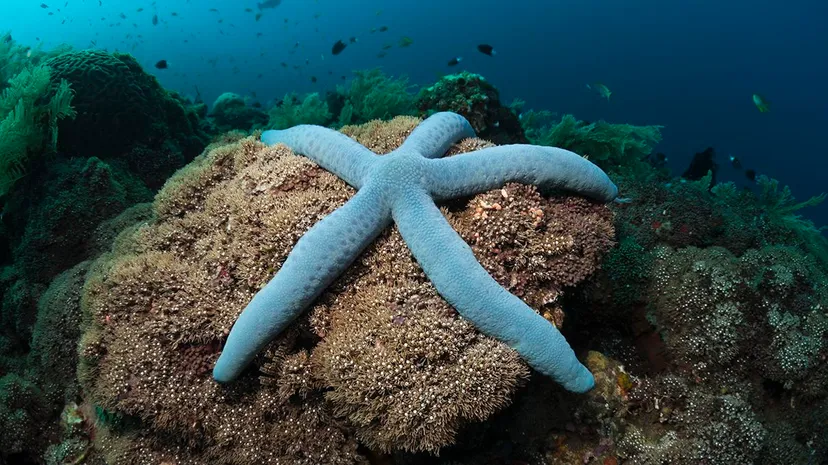
Starfish typically have a central disc and usually five arms, though some species have a larger number of arms. The aboral or upper surface may be smooth, granular or spiny, and is covered with overlapping plates. Many species are brightly coloured in various shades of red or orange, while others are blue, grey or brown. Starfish have tube feet operated by a hydraulic system and a mouth at the centre of the oral or lower surface. They are opportunistic feeders and are mostly predators on benthic invertebrates. Several species have specialized feeding behaviours including eversion of their stomachs and suspension feeding. They have complex life cycles and can reproduce both sexually and asexually. Most can regenerate damaged parts or lost arms and they can shed arms as a means of defense.

Appearance

Most starfish have five arms that radiate from a central disc, but the number varies with the group. Some species have six or seven arms and others have 10–15 arms. In Antarctic Labidiaster annulatus, the number of arms can exceed fifty. Evidence from gene expression finds that the starfish body corresponds to a head externally (with lips attached to the tube feet) and a torso internally.

Diet

Most species are generalist predators, eating microalgae, sponges, bivalves, snails and other small animals. The crown-of-thorns starfish consumes coral polyps, while other species are detritivores, feeding on decomposing organic material and faecal matter. A few are suspension feeders, gathering in phytoplankton; Henricia and Echinaster often feed with sponges, taking advantage of the water current they produce. Various species can absorb organic nutrients from the surrounding water, and this may form a significant portion of their diet.

Behaviour

Starfish live in marine waters around the world including both tropical and polar waters. They are mainly benthic animals, living in sandy, muddy and rocky substrates. They range from shallow, intertidal waters to the deep-sea floor down to at least 6,000 m (20,000 ft). Starfish are most common along the coast.

Reproduction

Most species of starfish are gonochorous, with there being separate male and female individuals. Some species are simultaneous hermaphrodites, producing eggs and sperm at the same time, and in a few of these the same gonad, called an ovotestis, produces both eggs and sperm. Other starfish are sequential hermaphrodites. Protandrous individuals of species like Asterina gibbosa start life as males before changing sex into females as they grow older. In some species such as Nepanthia belcheri, a large female can split in half and the resulting offspring are males. When these grow large enough they change back into females.

Humans & conservation

Starfish may be preyed on by conspecifics, other starfish species, tritons, crabs, fish, gulls, and sea otters. Their first lines of defence are the saponins present in their body walls, which have unpleasant flavours. Some starfish such as Astropecten polyacanthus also include powerful toxins such as tetrodotoxin, while the slime star can ooze out large quantities of repellent mucus. The crown-of-thorns starfish possesses sharp spines, toxins and bright warning colours.

Several species sometimes suffer from a wasting condition caused by Vibrio bacteria. A more widespread sea star wasting disease sporadically causes mass mortalities. The results of a 2025 study of starfish off the coast of central British Columbia suggest that those living in the fjords can better survive outbreaks of the disease due to the lower temperatures and higher salinity of their environment.

Where to see it

Top-rated dive sites where divers have spotted Starfish.

San Carlos Beach (Breakwater Cove)
United States, California, Monterey Monterey Bay National Marine Sanctuary
San Carlos Beach (Breakwater Cove) is a protected, accessible dive site for all levels, featuring a sandy entry, a wall, pipe, and Metridium anemones. Max depth 50-60ft.
👣 Shore All levels
Dado Pequeño

Dado Pequeño

⭐ 4.0 Scout Score
Spain, Ibiza Formentera Parque natural de ses Salines d'Eivissa i Formentera
Vibrant Ibiza wall dive with rich Mediterranean macro life.
🚤 Boat intermediate
Portia

Portia

⭐ 4.0 Scout Score
An ever-changing cold-water wreck dive on shifting sands.
🚤 Boat intermediate
Knife Rock

Knife Rock

⭐ 4.0 Scout Score
Sri Lanka, Trincomalee Pigeon Island Marine Park
Shallow dive with diverse landscapes, reef life, and history.
🚤 Boat beginner
Žusterna

Žusterna

⭐ 3.0 Scout Score
Slovenia, Koper Not in marine park
Easy shore dive, great for macro and night diving.
👣 Shore Beginner
Kaloutsi Reef

Kaloutsi Reef

⭐ 4.0 Scout Score
Expansive reef system with abundant and diverse marine life.
🚤 Boat all levels
Bahia Ensueño

Bahia Ensueño

⭐ 3.0 Scout Score
Peaceful beginner boat dive with diverse fish and invertebrates.
🚤 Boat beginner
Long Dong #2 龍洞 2號
👣 Shore Beginner
Isola Bella South

Isola Bella South

⭐ 4.0 Scout Score
Italy, Sicily, Taormina Riserva Naturale Orientata Isola Bella
Mediterranean maze of swim-throughs and fascinating rock formations.
🚤 Boat all levels
Lungomare Beach

Lungomare Beach

⭐ 4.0 Scout Score
Italy, Sardinia, Cala Gonone Gulf of Orosei and Gennargentu National Park
Shallow shore dive with rocky reefs, great for beginners.
👣 Shore beginner
Kalogria

Kalogria

⭐ 4.0 Scout Score
Scenic Halkidiki shore dive with clear water for all levels.
👣 Shore all levels
Panorama Beach

Panorama Beach

⭐ 4.0 Scout Score
Ideal beginner beach dive perfect for Open Water training.
👣 Shore beginner
Lynch Blinder

Lynch Blinder

⭐ 4.0 Scout Score
Saldanha Bay rock formation dive
🚤 Boat Beginner
Poyraz Koyu

Poyraz Koyu

⭐ 4.0 Scout Score
Rocky reef dive with diverse marine life
🚤 Boat Intermediate
Marine de Ficaghjola

Marine de Ficaghjola

⭐ 4.0 Scout Score
Accessible cove with pink cliffs, clear sea, octopus and seabream.
👣 Shore Beginner
Blue Lagoon

Blue Lagoon

⭐ 4.0 Scout Score
Croatia, Trogir Not in marine park
Shallow, crystal-clear lagoon with stunning turquoise water.
🚤 Boat All levels
La Draga

La Draga

⭐ 4.0 Scout Score
Shallow shipwreck dive with diverse Mediterranean marine life.
🚤 Boat beginner
Playa Seghers

Playa Seghers

⭐ 4.0 Scout Score
Calm, sheltered bay ideal for beginner and introductory dives.
👣 Shore Beginner
Via Crucis Underwater Museum

Via Crucis Underwater Museum

⭐ 4.0 Scout Score
Croatia, Trogir Not in marine park
Unique underwater museum with 52 life-sized religious statues.
🚤 Boat Beginner
Secca delle Stelle

Secca delle Stelle

⭐ 4.0 Scout Score
Beginner-friendly Italian dive site with abundant marine life
🚤 Boat Beginner