← All marine life
Staghorn Coral
Species IUCN · Critically Endangered (CR)

Staghorn Coral

Acropora cervicornis, (Lamarck, 1816)

marine

About Staghorn Coral

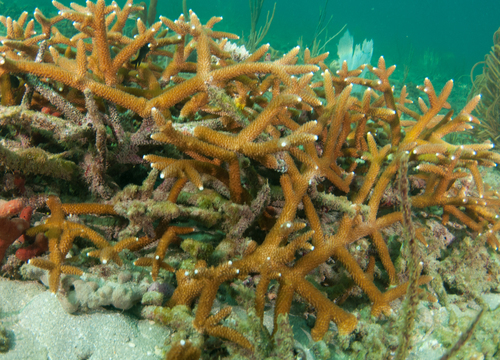
The staghorn coral (Acropora cervicornis) is a branching, stony coral, within the Order Scleractinia. It is characterized by thick, upright branches which can grow in excess of 2 meters (6.5 ft) in height and resemble the antlers of a stag, hence the name, Staghorn. It grows within various areas of a reef but is most commonly found within shallow fore and back reefs, as well as patch reefs, where water depths rarely exceed 20 meters (65 ft). Staghorn corals can exhibit very fast growth, adding up to 5 cm (~2 in) in new skeleton for every 1 cm of existing skeleton each year, making them one of the fastest growing fringe coral species in the Western Atlantic. Due to this fast growth, Acropora cervicornis, serve as one of the most important reef building corals, functioning as marine nurseries for juvenile fish, buffer zones for erosion and storms, and center points of biodiversity in the Western Atlantic.

Up until the late 1970s, much of the fore reef zones within the Atlantic around the coasts of Southern Florida and the Caribbean Islands were covered with vast, dense colonies of Staghorn coral consisting largely of single-species stands; however, a combination of white-band disease and various anthropogenic factors have reduced this coral coverage by over 95% in some areas.

Habitat

Staghorn coral is most commonly found within 20 meters (65 ft) of the water's surface, in clear, non-turbid environments consistent with fore, back and patch reefs in the Western Atlantic Ocean. In this environment, water temperatures typically range anywhere from 66 to 80 degrees Fahrenheit (19 - 27 degrees Celsius) with salinity ranging from 33 to 37 ppt (parts per thousand).

Diet

Like the vast majority of coral species, Staghorn coral are both autotrophic and heterotrophic, meaning they have two main methods of acquiring the nutrients needed to sustain their growth and continued survival.

The first and most important method is autotrophic and comes from the photosynthetic symbiotic zooxanthellae that inhabit the tissue of the Staghorn. This method accounts for up to 90% of their total nutritional requirements.

Reproduction

There are two methods by which Staghorn corals can produce, asexually and sexually.

Humans & conservation

Overfishing is one of the biggest threats to coral reefs not only in the Caribbean and Western Atlantic where the Staghorn inhabits, but on many coral reefs around the world. The effects of overfishing are wide ranging, and can lead to an overgrowth of sponges by as much as 25% as their predators are systematically fished out and removed from the ecosystem. As sponges grow uninhibited, they outcompete, smother and prevent the settlement of coral planula as they become the dominant habitat forming organisms on the reef.

Part of

Where to see it

No dive sites list Staghorn Coral yet. Explore the map to find sites near you.