
← All marine life
Squirrelfish
Group

Squirrelfish

Beryciformes

marinebrackish

About Squirrelfish

The Beryciformes are a poorly-understood order of carnivorous ray-finned fishes consisting of 7 families, 30 genera, and 161 species. They feed on small fish and invertebrates. Beyond this, little is known about the biology of most member species because of their nocturnal habits and deepwater habitats.

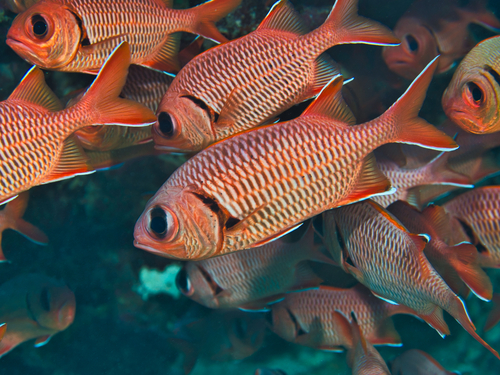
All beryciform species are marine and most live in tropical to temperate, deepwater environments. Most live on the continental shelf and continental slope, with some species being found as deep as 2,000 m (6,600 ft). Some species move closer to the surface at night, while others live entirely in shallow water and are nocturnal, hiding in rock crevices and caves during the day. Several species are mesopelagic and bathypelagic. Beryciformes' bodies are deep and mildly compressed, typically with large eyes that help them see in darker waters. Colors range from red to yellow and brown to black, and sizes range from 8–61 cm (3.1–24.0 in). Member genera include the alfonsinos, squirrelfishes, pricklefishes, and whalefishes. A number of member species are caught commercially, including the alfonsino and the splendid alfonsino.

Humans & conservation

The Beryciformes are generally not important to humans, and their trend towards living in deeper waters generally keeps many species away from human activity. Several species are found in the aquarium trade, however. Pineapplefishes are of interest to fishkeepers for their bright colors, while squirrelfishes' shallower reef habitats and bright red colors make them more easily collected. Flashlight fishes are also kept as pets because of the bioluminescent organs underneath their eyes. The alfonsinos and orange roughy are of a different interest to humans, targeted by deepwater commercial fisheries. Increased catches could lead to steep population declines for these species as their extended lifespans make them vulnerable to overfishing. The orange roughy, for example, can live up to 149 years, but takes anywhere from 23 to 40 years to begin reproducing.

Where to see it

No dive sites list Squirrelfish yet. Explore the map to find sites near you.