
← All marine life
Spiny Seahorse
Species IUCN · Vulnerable (VU)

Spiny Seahorse

Hippocampus histrix, Kaup, 1856

marine

About Spiny Seahorse

The spiny seahorse (Hippocampus histrix), also referred to as the thorny seahorse, is a small marine fish in the family Syngnathidae, native to the Indo-Pacific area. It is classified as a Vulnerable species by the IUCN.

Appearance

The spiny seahorse is a small fish that can reach a maximum length of 15–17 cm.

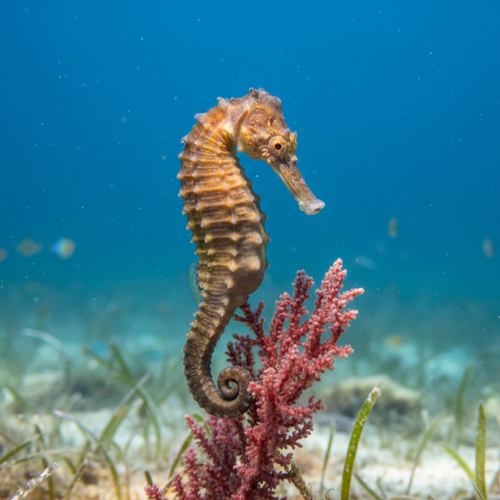
The body is slender, elongated and completely covered with thorns. These are sharp with dark tips, and uniformly sized on the prehensile tail. The trunk has long thorns which continue until the coronet, which has 4–5. The head is also provided with numerous spines especially on the forehead, the base of the cheeks, the nose and above the eyes. The snout is very long and tapered. Body coloration is highly variable to match surroundings and goes from grey to cream, and from bright yellow, to green or red and even brownish. It can be plain or with different pattern on the side or/and on the backside. The snout is generally striped with one or more thin white lines.
Habitat

The spiny seahorse is relatively rare but widespread throughout the Indo-Pacific. In Australia it has been reported from the south of Ashmore Reef, Timor Sea, the Great Barrier Reef, Queensland, and in Port Stephens, New South Wales. It is also found at Bali, Indonesia, Papua New Guinea, New Caledonia and Japan. The species favours relatively deep waters (10–95 m) and is usually found below 15 m depths. This species is found on a variety of substrates including sponges, weedy rocky reefs, soft corals but mainly on seagrass beds.

Humans & conservation

H. histrix is listed as vulnerable by the IUCN. Populations are thought to have declined by more than 30% over the last 10-15 years. It is subject both to targeted exploitation for use in traditional medicine and the aquarium trade, and to population losses from bycatch in the shrimp fishery. Inshore sea-grass habitats frequented by the species are also in decline. Like all seahorses, it is listed in Appendix II of the Convention on International Trade in Endangered Species of Wild Fauna and Flora (CITES), meaning that it is on the list of species the trade of which must be controlled to ensure their survival. As most seahorses enter trade as bycatch, imposing export quotas would achieve next to nothing for wild populations.

Part of

Where to see it

No dive sites list Spiny Seahorse yet. Explore the map to find sites near you.