
← All marine life
Spinner Shark
Species IUCN · Vulnerable (VU)

Spinner Shark

Carcharhinus brevipinna, (Müller & Henle, 1839)

marine

About Spinner Shark

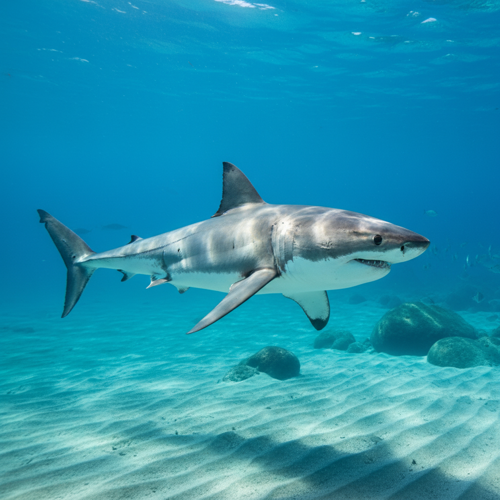
The spinner shark (Carcharhinus brevipinna) is a type of requiem shark, in the family Carcharhinidae, named for the spinning leaps it makes as a part of its feeding strategy. This species occurs in tropical and warm temperate waters worldwide, except for in the eastern Pacific Ocean. It is found from coastal to offshore habitats to a depth of 100 m (330 ft), though it prefers shallow water. The spinner shark resembles a larger version of the blacktip shark (C. limbatus), with a slender body, long snout, and black-marked fins. This species can be distinguished from the blacktip shark by the first dorsal fin, which has a different shape and is placed further back, and by the black tip on the anal fin (in adults only). It attains a maximum length of 3 m (9.8 ft).

Appearance

The average spinner shark is 2 m (6.6 ft) long and weighs 56 kg (123 lb); this species attains a maximum known length and weight of 3 m (9.8 ft) and 90 kg (200 lb). Indo-Pacific sharks are generally larger than those from the northwest Atlantic. This species has a slim, streamlined body with a distinctive, long, pointed snout. The eyes are small and circular. Prominent, forward-pointing furrows occur at the corners of the mouth. The tooth rows number 15–18 in each half of the upper jaw and 14–17 in each half of the lower jaw, with two and one tiny symphysial (central) teeth, respectively. The teeth have long, narrow central cusps and are finely serrated in the upper jaw and smooth in the lower jaw. The five pairs of gill slits are long.
Habitat

Some uncertainty exists in the distribution data for the spinner shark due to confusion with the blacktip shark. In the Western Atlantic Ocean, it occurs from North Carolina to the northern Gulf of Mexico, including the Bahamas and Cuba, and from southern Brazil to Argentina. In the Eastern Atlantic, it occurs from off North Africa to Namibia. In the Indian Ocean, it is found from South Africa and Madagascar, to the Red Sea and the Gulf of Aden, to India and nearby islands, to Java and Sumatra. In the Pacific Ocean, it occurs off Japan, Vietnam, Australia, and possibly the Philippines. Parasitological evidence suggests that Indian Ocean spinner sharks have passed through the Suez Canal into the Mediterranean Sea, becoming Lessepsian migrants.

Diet

Spinner sharks feed primarily on small bony fish, including tenpounders, sardines, herring, anchovies, sea catfish, lizardfish, mullets, bluefish, tunas, bonito, croakers, jacks, mojarras, grunts, and tongue-soles. They have also been known to eat stingrays, cuttlefish, squid, and octopus. Groups of spinner sharks are often found pursuing schools of prey at high speed. Individual prey are seized and swallowed whole, as this shark lacks cutting dentition. This species employs an unusual tactic when feeding on schools of small fish; the shark charges vertically through the school, spinning on its axis with its mouth open and snapping all around it. The shark's momentum at the end of these spiraling runs often carries it into the air, giving it its common name. The blacktip shark also performs this behavior, though not as often.

Behaviour

The spinner shark is a fast, active swimmer that sometimes forms large schools, segregated by age and sex. Young individuals prefer cooler water temperatures than adults. Off South Africa, females are found close to shore year-round, while males only appear during the summer. Smaller spinner sharks may be preyed upon by larger sharks. Known parasites of the spinner shark include the copepods Kroyeria deetsi, Nemesis pilosus, and N. atlantica, which infest the shark's gills, Alebion carchariae, which infests the skin, Nesippus orientalis, which infests the mouth and gill arches, and Perissopus dentatus, which infests the nares and the rear margins of the fins.

Humans & conservation

Ordinarily, spinner sharks do not pose a substantial danger to humans; they do not perceive large mammals as prey, as their small, narrow teeth are adapted for grasping rather than cutting. However, they can become excited by the presence of food, so caution is warranted if this species is encountered while spearfishing. As of 2008, the International Shark Attack File listed 16 unprovoked attacks and one provoked attack attributable to the spinner shark, none of them fatal.

Part of

Where to see it

No dive sites list Spinner Shark yet. Explore the map to find sites near you.