
← All marine life
Spanish Flag Snapper
Species IUCN · Least Concern (LC)

Spanish Flag Snapper

Lutjanus carponotatus, (Richardson, 1842)

marine

About Spanish Flag Snapper

Lutjanus carponotatus, the Spanish flag snapper, stripey snapper, dusky-striped sea-perch, gold-banded sea perch, gold-stripe sea-perch, striped seaperch or stripey seaperch, is a species marine ray-finned fish, a snapper belonging to the family Lutjanidae. It is native to the western Pacific and Indian Oceans, from India to northern Australia.

Appearance

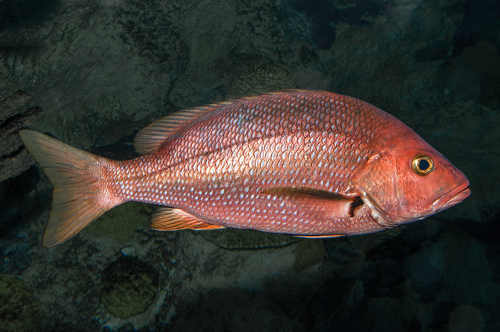
Lutjanus carponotatus has a moderately deep body which has a depth of around 2.5 times its standard length. The snout is rather pointed, with a steep dorsal profile. The knob and incision on the preoperculum are weakly developed. The vomerine teeth may be arranged in a triangular patch with a posterior extension or in a rhombus shaped patch and there is a small patch of grain like teeth on the tongue. The dorsal fin contains 10 spines and 14-16 soft rays while the anal fin has 3 spines and 9 soft rays. The rear part of the dorsal fin and the anal fin are rounded in shape, the pectoral fin has 15 to 17 rays and the caudal fin is emarginate. The scale rows on the back rise diagonally from the lateral line. The maximum total length recorded for this species is 40 cm (16 in) although 30 cm (12 in) is more typical.
Habitat

Lutjanus carponotatus has a distribution in the Indo-West Pacific. Their range extends from the Andaman Sea coast and Bay of Bengal in western India east to Papua New Guinea north to the coasts of the South China Sea and south to northern Australia. In Australia it is found from Shark Bay in Western Australia east to Moreton Bay in Queensland, possibly reaching south as far as northern New South Wales, it also occurs on reefs in the Coral Sea. They are found at depths between 2 and 80 m (6 ft 7 in and 262 ft 6 in), although they are rarely recorded below 15 m (49 ft). The adults are found in coral reefs, both in sheltered lagoons and on the outer slopes, often found in turbid coastal waters. The juveniles are found in the back reef near the shore where there are tabular and corymb-like Acropora corals with a sandy substrate.

Humans & conservation

Lutjanus carponotatus is an important species for artisanal, recreational and commercial fisheries throughout its range. It is caught mostly with handlines or rod and reel (Australia), traps and gill nets. It is targeted by recreational fishers in Western Australia. It is also caught by trawlers. In Australia the catch of this species makes up less than 10% of the fish landed by the commercial line fishery on the Great Barrier Reef. In the Philippines and Indonesia it is a commercially targeted species but landing statistics are unavailable. This fish is normally sold fresh at market.

Part of

Where to see it

No dive sites list Spanish Flag Snapper yet. Explore the map to find sites near you.