
← All marine life
Species

Southern Boxfish

Ostracion cubicus, Linnaeus, 1758

marine

About Southern Boxfish

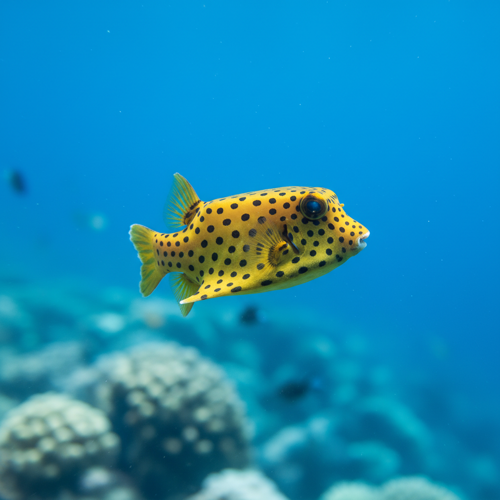
The yellow boxfish (Ostracion cubicum) is a species of marine ray-finned fish belonging to the family Ostraciidae, the boxfishes. This species is found in reefs throughout the Pacific Ocean and Indian Ocean as well as the southeastern Atlantic Ocean, although since 2011 it has also been occasionally recorded in the Levantine waters of the Mediterranean Sea which it likely entered via the Suez Canal. The species is present in the aquarium trade. They are known for their cuboid body shape, bright yellow and black spotted coloration, and the secretion of a toxic mucus when threatened.

Appearance

The yellow boxfish reaches a maximum length of 45 centimetres (18 in). As the name suggests, it is box-shaped. Boxfish are also known for their armored and rigid body called a carapace, covering the head and body. There are openings in the carapace for the mouth, nostrils, gill opening, anus, caudal peduncle, and fins. The rigid body shape provided by the carapace surrounding the body was thought to help the fish stabilize while swimming as the water flows over the body. It was thought to keep them on course in high-flow, turbulent conditions. However, the carapace was found to have little effect on stability. In fact, it was destabilizing, as it increased drag. Instead, the caudal fin is the stabilizing force and acts as a rudder.
Habitat

The yellow boxfish has a wide Indo-Pacific distribution which extends from the Red Sea and the eastern coast of Africa as far south as South Africa east to Hawaii, north to Japan and south to northern New Zealand. It has been recorded in the eastern Mediterranean Sea, probably having travelled through the Suez Canal. This species is found at depths between 1 and 75 m (3 ft 3 in and 246 ft 1 in) on sheltered coastal and offshore coral reefs and in areas of flat seabed.

They are adapted to be able to maneuver through the channels and crevices of coral reefs, as well as consume the benthic invertebrates that also live in the reefs.

Diet

The yellow boxfish's diet consists mainly of benthic organisms and marine algae. Their diets may also include worms, sponges, crustaceans, molluscs, and small fish.

Humans & conservation

The yellow boxfish is listed as Least Concern according to the IUCN Red List.

In the Gulf of Aqaba, it was found that there were wild fish aggregations around gilt-head seabream farms. Most of these wild fish were reef fish, which includes the yellow boxfish. The abundance of wild fish was greater at the farm cages than in the open ocean. While fish farms can be advantageous for wild fish as they are able to eat the excess organic matter from the farms, it may be a conservation issue for the yellow boxfish. Fish farms experience escapes, which could lead to the spread of disease to the wild fish aggregating there. Additionally, with the influx of reef fishes at these farms, it could attract ecotourism and agrotourism. These are all threats to the yellow boxfish.

Part of

Where to see it

No dive sites list Southern Boxfish yet. Explore the map to find sites near you.

Sources