
← All marine life
Southern Blue-Ringed Octopus
Species IUCN · Least Concern (LC)

Southern Blue-Ringed Octopus

Hapalochlaena maculosa, (Hoyle, 1883)

marine

About Southern Blue-Ringed Octopus

The southern blue-ringed octopus (Hapalochlaena maculosa) is one of four extremely venomous species of blue-ringed octopuses. It is most commonly found in tidal rock pools along the south coast of Australia. As an adult, it can grow up to 20 centimetres (8 in) long (top of the mantle to the tip of the arms) and on average weighs 26 grams (0.9 oz). They are normally a docile species, but they are highly venomous, possessing venom capable of killing humans. Their blue rings appear with greater intensity when they become aggravated or threatened.

Appearance

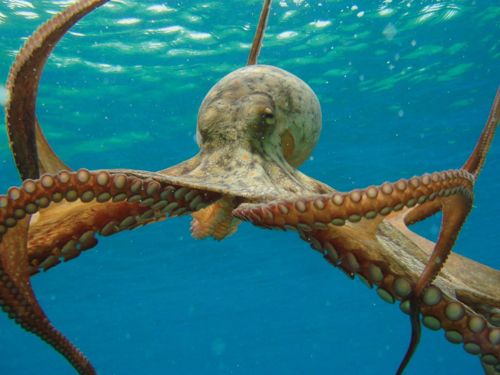
The blue-ringed species are known for their small size, yet the southern variety is hailed as the largest of the genus. As a result, they have been classified as their own species. From arm to arm, most of these octopuses are no larger than 20 centimeters. This is larger by roughly 5 centimeters on average with other varieties of the blue-ringed octopus. When at peace, their coloring is often a drab, mucus like color. However, once it feels sufficiently threatened, the eponymous blue-rings suddenly appear. These octopuses have an average of about 60 rings that have multilayer reflectors that allow them to flash a blue green color. These rings typically appear about 6 weeks after hatching (Mäthger et al.). For the rings to illuminate and glow, the muscles around the rings must contract while the muscles above them must relax (Mäthger et al.).
Habitat

Found along the southern coasts of Australia, H. maculosa inhabits crevasses and cracks in the rocky reefs signature to this section of the Australian coast. In addition, the octopus enjoys a proximity to the plentiful forests of seagrass.

Diet

The prey of H. maculosa consists mostly of lobsters, crabs, shrimp, and shellfish (including bivalve mollusks), as well as the occasional small fish. H. maculosa makes use of its venom for feeding purposes. It pins down and injects it through its beak. This totally paralyzes its prey, often killing it outright. This readies it for feeding. Another tactic it uses to hunt is releasing its venom as a mist into a location where its prey is commonly found. Their prey swim into the venom and become paralyzed, allowing for an attack.

Behaviour

Southern blue-ringed octopuses tend to be passive and relatively harmless: they generally use their toxins only when hunting or provoked. They are nocturnal. They expel a jet of water for propulsion. Like other members of the genus, they live in burrows.

Reproduction

H. maculosa has a very short life span with a large importance placed on reproduction. The average life span of a southern blue ringed octopus is around seven months. The octopus reaches sexual maturity at around four months old, at which time it focuses its last few months of life towards copulation and breeding. Both genders of this species are promiscuous, as they only have a limited set of gametes. The mating ritual of H. maculosa usually begins with the female initiating reproduction by changing color and posture. The male then mounts the female, inserts the hectocotylus under the mantle of the female, and releases the sperm into the female's oviduct. For this type of octopus, there is approximately a two-month window in which a female acquires and stores sperm from multiple males. She then carries the eggs with her, as opposed to depositing them somewhere stationary.

Humans & conservation

There are currently no known conservation efforts for the southern blue-ringed octopus. This being said, it is likely that H. maculosa play an important role in their ecosystem, perhaps by controlling crustacean populations, so any efforts to conserve this species would be expected to benefit other species in the same habitat. It is also suggested that because the dispersal ability of H. maculosa is limited, connectivity between different populations of the species is especially vulnerable to habitat fragmentation or geographic barriers.

Part of

Where to see it

No dive sites list Southern Blue-Ringed Octopus yet. Explore the map to find sites near you.