
← All marine life
Snoek
Species

Snoek

Thyrsites atun, (Euphrasen, 1791)

marinebrackish

About Snoek

Leionura atun (Euphrasén, 1791), known as the snoek in South Africa and as the barracouta in Australasia, is a long, thin species of snake mackerel found in the seas of the Southern Hemisphere, and a common food fish in South Africa, particularly along the west and southwest coast. Despite its Australasian name, it is not closely related to the barracuda.

Appearance

The fish can reach a length of 200 cm (79 in) SL though most do not exceed 75 cm (30 in) SL. The maximum recorded weight for this species is 6 kilograms (13 lb). It is very important to commercial fisheries and is also a popular game fish. It is currently the only known member of its genus.

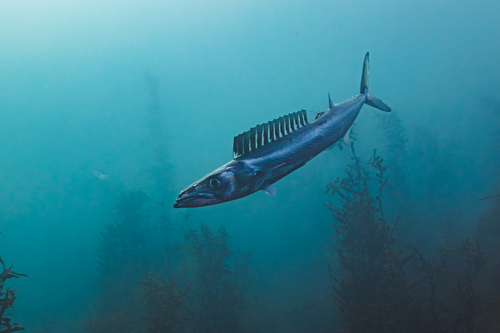
L. atun has 19 to 21 dorsal spines and about 113 dorsal rays, 1 anal spine and 10 to 13 anal rays, 35 vertebrae. The body is elongate and compressed, with a single lateral line on the upper body then curving ventrally. Body colour is blue-black on top with a paler belly, first dorsal fin is black. It is believed to contain an anticoagulant in its bite, but this is not supported by scientific research.

Habitat

Leionura atun is widely distributed in the colder waters in the Southern Hemisphere. In the southwest Atlantic, it is known from Uruguay, Argentina and Tierra del Fuego. In the eastern Atlantic, from Tristan da Cunha and South Africa. In the western Indian Ocean, from South Africa and the St. Paul and Amsterdam islands. In the eastern Indian Ocean, Tasmania and the southern coast of continental Australia. In the southwest Pacific, from New Zealand and the southern coast of Australia. In the southeast Pacific, from southern Peru, Chile, and Tierra del Fuego.

On the African coast, it is found from Moçâmedes in northern Angola, along the coast of Namibia and the coast of the Northern Cape and Western Cape provinces of South Africa as far east as Algoa Bay, but mostly between the Kunene River and Cape Agulhas.

Diet

In the South African population 50% sexual maturity occurs at 3 years at a fork length of about 73 cm (29 in).

Spawning occurs during winter and spring, (May to November with a peak from June to October) along the continental shelf break of the western Agulhas bank and the South African west coast, at a depth of between 150 and 400 m (490 and 1,310 ft). The eggs and larvae are transported by currents to the primary nursery area north of Cape Columbine and the secondary nursery area east of Danger Point, where the juveniles remain until maturity.

L. atun eggs hatch about 50 hours after fertilization, and the larvae initially eat phytoplankton, first feeding at 3.5 mm (0.14 in), about 3 to 4 days after hatching. When they reach about 8 mm long, they start eating the larvae of other fishes, which are most abundant during spring and summer in this region.

Behaviour

This species will form schools near the bottom or midwater; sometimes even near the surface at night. It prefers sea water temperature between 13 and 18 °C (55 and 64 °F).

Leionura atun are reputed to attack anything that moves near them in the water.

Humans & conservation

L. atun is important as a food fish over a large part of its distribution. It supports moderate fisheries off southern Australia, Chile, and Tristan da Cunha, and major fisheries off New Zealand and southern Africa.

The South African snoek fisheries have been of commercial importance since the early 1800s. Originally purely a line-fish, they are also caught by pelagic and demersal trawling.

The fish was one of the most important traditional foods of Ngāi Tahu, the Māori people of the South Island of New Zealand. The fish is known in Māori as mangā, or makā in southern dialects. The name mangā is common in Polynesian languages to describe Scombriformes, and fish of a similar appearance.

Where to see it

No dive sites list Snoek yet. Explore the map to find sites near you.