
← All marine life
Small-Mouthed Wrasse
Species IUCN · Least Concern (LC)

Small-Mouthed Wrasse

Centrolabrus exoletus, (Linnaeus, 1758)

marine

About Small-Mouthed Wrasse

The rock cook (Centrolabrus exoletus), or small-mouthed wrasse, is a species of marine ray-finned fish from the wrasse family Labridae which is found in the eastern Atlantic Ocean off the coasts of Europe.

Appearance

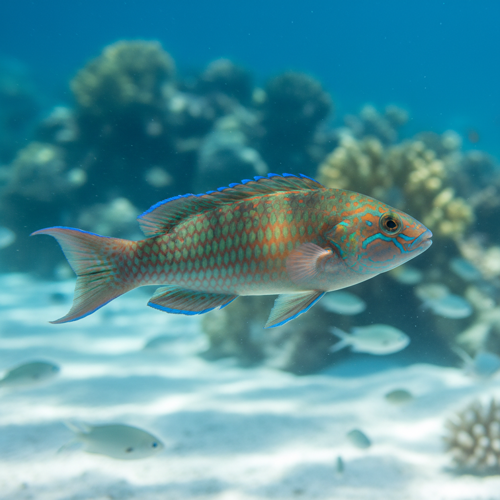
The rock cook is a small wrasse in which the adults range in length from 10–15 centimetres (3.9–5.9 in). Its mouth is relatively small and has thick, fleshy lips. This species is normally reddish-brown above fading to yellowish-silver on the flanks and to pale silvery-white on the belly. The males have iridescent blue streaks on their dorsal, anal and caudal fins as well as on their heads. The caudal fin has a dark vertical bar. There is a single row of small teeth in the jaws.
Habitat

The rock cook is found in the eastern Atlantic where it is endemic to European waters from Norway to Portugal. It has been claimed off eastern Greenland but these records are regarded as doubtful. It is absent from the Baltic Sea and has been observed once in the Mediterranean Sea off Málaga in 1981. In the waters off Britain and Ireland it is absent from the eastern English Channel and the eastern coast of England.

Humans & conservation

The rock cook is used in the aquaculture of the Atlantic salmon as a cleaner fish.

Part of

Where to see it

No dive sites list Small-Mouthed Wrasse yet. Explore the map to find sites near you.