
← All marine life
Slingjaw Wrasse
Species IUCN · Least Concern (LC)

Slingjaw Wrasse

Epibulus insidiator, (Pallas, 1770)

marine

About Slingjaw Wrasse

The slingjaw wrasse (Epibulus insidiator) is a species of wrasse from the family Labridae which is native to the tropical waters of the Indo-Pacific where it occurs around coral reefs. Along with its sister species in the genus Epibulus, this species is notable for its highly protrusible jaws, an adaptation for feeding in complex aquatic environments. This species is of minor importance to local commercial fisheries and can be found in the aquarium trade.

Appearance

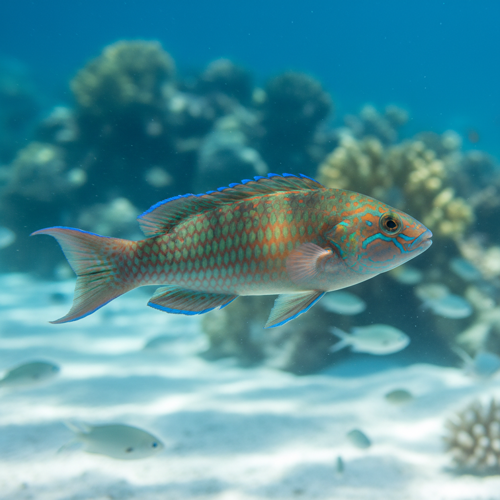
Juveniles are brown with thin white bars on their flanks and white lines radiating out from their eyes, while the females can be either bright yellow or dark brown. The yellow female morph may potentially be an instance of mimicry, being a similar shade to a number of damselfish species.

The males of this species are greyish-brown with orange on the back, a yellowish transverse bar on the flank and a pale grey to white head which is marked with a thin black stripe running through the eye. The scales of the male's body are edged with darker pigment. Intermediately patterned individuals which have yellow blotches, a pale tail and sometimes with black pectoral fins do occur.

The dorsal fin has 9–10 spines and 9–11 soft rays while the anal fin has 3 spines and 8–9 soft rays. The largest specimens may attain a standard length of 54 centimetres (21 in).
Habitat

The slingjaw wrasse is found in a wide area of the Indo-Pacific region from the eastern coast of Africa including Madagascar and the Red Sea, through the Indian Ocean coastline and islands into the Pacific, as far east as Johnston Atoll in Hawaii, although vagrants sometimes occur in the main Hawaiian chain. It reaches north to Japan and south to New Caledonia. It is also found along the northern coasts of Australia from the Houtman Abrolhos archipelago to reefs of the Coral Sea off Queensland.

Reproduction

This species is likely to exhibit protogynous hermaphrodity, first maturing as a female and later on transitioning to male. Males hold a territory with an area of 500–1,000 square metres (5,400–10,800 ft2) and a number of females appear to have their home ranges within his territory. The colour of the males was observed to become more intense during courtship, and they also swim with their caudal fin collapsed and held upwards at an angle while the anal fin was folded and stretched downwards. The intensity of the male's colour can return to normal when they feel threatened. Spawning took place around high tide. When spawning the pair were observed to ascend 2–3 metres (6.6–9.8 ft). Spawning seems to be initiated by the females and has been recorded in March, April, May, July, September and October.

Humans & conservation

The slingjaw wrasse is collected for food in many parts of its range, and it is also collected for the aquarium trade. In the two decades leading up to 2008, the average body size of the fish caught in Guam did not decline. The species is considered of least concern by the International Union for Conservation of Nature.

Part of

Where to see it

No dive sites list Slingjaw Wrasse yet. Explore the map to find sites near you.