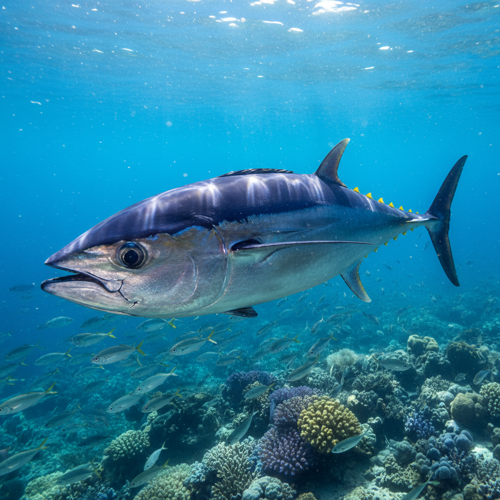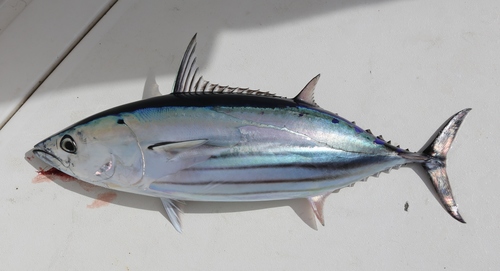
Appearance
It is a streamlined, fast-swimming pelagic fish common in tropical waters throughout the world, where it inhabits surface waters in large shoals (up to 50,000 fish, often in combination with other scombridaes), feeding on fish, crustaceans, cephalopods, and mollusks. It is an important prey species for sharks and large pelagic fishes and is often used as live bait when fishing for marlin. It has no scales, except on the lateral line, and circling around the body behind the head forming a large, thick band called a "corselet". Like other tuna, it lacks a swim bladder, and must keep swimming to stay buoyant. It commonly reaches fork lengths up to 80 cm (2 ft 7 in) and a mass of 8–10 kg (18–22 lb). Its maximum fork length is 108 cm (3 ft 7 in), and its maximum mass is 34.5 kg (76 lb).