
← All marine life
Silvertip Shark
Species IUCN · Vulnerable (VU)

Silvertip Shark

Carcharhinus albimarginatus, (Rüppell, 1837)

marine

About Silvertip Shark

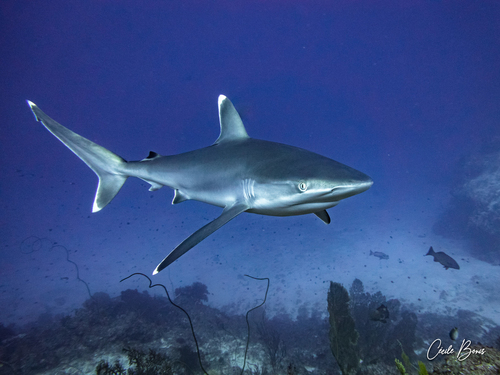
The silvertip shark (Carcharhinus albimarginatus) is a large species of requiem shark in the family carcharhinidae, with a fragmented distribution throughout the tropical Indian and Pacific Oceans. It is often encountered around offshore islands and coral reefs, and has been known to dive to a depth of 800 m (2,600 ft). The silvertip shark resembles a larger and bulkier grey reef shark (C. amblyrhynchos), but can be easily identified by the prominent white margins on its fins. It attains a maximum length of 3 m (10 ft).

It feeds on a wide variety of bony fishes, as well as eagle rays, smaller sharks, and cephalopods. This species dominates other requiem sharks of equal size when competing for food, and larger individuals are often heavily scarred from conflicts with others of its species. As with other members of its family, the silvertip shark is viviparous, with females giving birth to one to 11 pups in the summer. Silvertip sharks are regarded as potentially dangerous to humans, as they often approach divers quite closely. This slow-reproducing species is taken by commercial fisheries for its meat, fins, skin, cartilage, and jaws and teeth, which has apparently led to local population declines or extirpations.

Appearance

The silvertip shark is a robust and streamlined species with a moderately long, broad snout and large, round eyes. The five pairs of gill slits are short. It has 12–14 tooth rows on each side of both jaws, with one or two small teeth at the symphysis (middle of the jaws). The upper teeth are broad with oblique triangular cusps and coarse serrations near the base; the lower teeth have erect cusps with fine serrations. The first dorsal fin is large and triangular, originating above or slightly forward of the free pectoral fin tips. A ridge occurs between the first and second dorsal fins. The pectoral fins are proportionately longer than in most requiem sharks and falcate (sickle-like) in shape, with pointed tips.

Habitat

The silvertip shark is widely but not continuously distributed in the tropical Indian and Pacific Oceans. In the western Indian Ocean, this species occurs from the Red Sea to South Africa, including Madagascar, the Seychelles, the Aldabra Group, Mauritius and the Chagos Archipelago. In the western Pacific, it is known from off southern Japan to northern Australia, including Taiwan, the Philippines, Indonesia, Papua New Guinea, New Caledonia, Guam, Palau, the Solomon Islands, the Marshall Islands, the Phoenix Islands and Tahiti. In the eastern Pacific, it occurs from southern Baja California to Colombia, including the Cocos, Galapagos, and Revillagigedo Islands. Its presence in the Gulf of Mexico and the Caribbean Sea is unconfirmed.

Diet

The diet of the silvertip shark consists primarily of bony fishes, such as grouper, mackerel, tuna, bonito, lanternfish, flyingfish, escolar, bananafish, wahoo, wrasses, and soles. Eagle rays, smaller sharks, octopus, and squid are occasionally taken. Larger sharks tend to be more sluggish and take more benthic prey. The differently shaped dentition in their upper and lower jaws allows them to tackle large prey, gripping and sawing off chunks of flesh with violent twists and turns. Silvertip sharks have been observed swimming around the periphery of groups of feeding sharks of other species, occasionally dashing in to steal food. This species often approaches ships, as they are attracted to certain artificial, low-frequency sounds.

Behaviour

Though silvertip sharks are quite mobile, they exhibit fidelity to certain areas, with reports of territorial behavior. They are usually encountered alone or in pairs. Small groups of adult females have been seen in deep water. Individual silvertip sharks behave very aggressively towards one another, and many are heavily scarred. They are also reported to dominate Galapagos sharks (C. galapagensis) and blacktip sharks (C. limbatus) of equal size when competing for food. This shark sometimes forms mixed-species aggregations with grey reef sharks. Rainbow runners (Elagatis bipinnulata) have been observed rubbing against silvertip sharks, using the sharks' rough skin to scrape off parasites. They sometimes follow marine mammals such as bottlenose dolphins (Tursiops sp.) in open water, and are themselves followed by pilot fish (Naucrates ductor).

Humans & conservation

Inquisitive and bold, especially in the presence of food several sharks will rush up from deep water to inspect divers when they first enter the water, which can be a very intimidating experience, as they may approach quite close. This species has also been known to circle or pursue divers. In one experiment involving bait, a large silvertip shark tore the leg off a dummy dressed in SCUBA gear, demonstrating that this species is capable of inflicting lethal injuries. As of 2008, the International Shark Attack File listed four provoked attacks attributable to this species, none of them were fatal.

Where to see it

No dive sites list Silvertip Shark yet. Explore the map to find sites near you.