
← All marine life
Sicklefin Lemon Shark
Species IUCN · Endangered (EN)

Sicklefin Lemon Shark

Negaprion acutidens, (Rüppell, 1837)

marinebrackish

About Sicklefin Lemon Shark

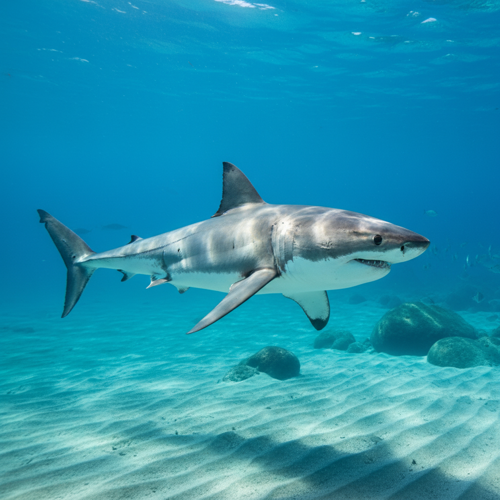
The sicklefin lemon shark (Negaprion acutidens) or sharptooth lemon shark is a species of requiem shark belonging to the family Carcharhinidae, widely distributed in the tropical waters of the Indo-Pacific. It is closely related to the better-known lemon shark (N. brevirostris) of the Americas; the two species are almost identical in appearance, both being stout-bodied sharks with broad heads, two dorsal fins of nearly equal size, and a plain yellow-tinged coloration. As its common name suggests, the sicklefin lemon shark differs from its American counterpart in having more falcate (sickle-shaped) fins. This large species grows up to 3.8 m (12 ft) long. It generally inhabits water less than 92 m (302 ft) deep in a variety of habitats, from mangrove estuaries to coral reefs.

Appearance

The sicklefin lemon shark has a robust, stocky body and a short, broad head. The snout is rounded or almost wedge-shaped, with small nostrils bearing triangular flaps of skin in front. The eyes are small, with no spiracles. Short furrows are present at the corners of the mouth. Thirteen to 16 (usually 14) tooth rows occur on either side of both jaws, not including the tiny teeth at the symphysis (the jaw midline). The upper teeth have a large cusp rising from a broad base, with a notch on each side; these teeth become increasingly angled towards the corners of the mouth. The lower teeth resemble the upper teeth, but are narrower and more erect. The teeth of sharks over 1.4 m (4.6 ft) long are finely serrated.
Habitat

The range of the sicklefin lemon shark extends from South Africa to the Red Sea (including Mauritius, the Seychelles, and Madagascar), continuing eastward along the coast of the Indian subcontinent to Southeast Asia, extending as far north as Taiwan and the Philippines, and as far south as New Guinea and northern Australia. This species is also found around numerous Pacific islands, including New Caledonia, Palau, the Marshall Islands, the Solomon Islands, Fiji, Vanuatu, and French Polynesia. This species likely colonized the central Pacific by infrequently "hopping" from one island to the next. Significant levels of genetic differentiation between sicklefin lemon sharks in Australia and French Polynesia, 7,500 km (4,700 mi) apart, suggest that little intermingling occurs between regional subpopulations.

Behaviour

A sluggish species, the sicklefin lemon shark is usually seen cruising sedately just above the sea bottom or lying still on it, as unlike most requiem sharks, it is capable of actively pumping water over its gills. However, it will approach the surface in pursuit of food. This shark seldom undertakes long-distance movements. A study at Aldabra Atoll in the Seychelles found, of the tagged sharks that were later recaptured, over 90% were still within 2 km (1.2 mi) of their initial tagging location. Another study at Moorea in French Polynesia found that some of the local sharks were year-round residents of the island, while others were more transitory and visited only occasionally.

Humans & conservation

Several apparently unprovoked attacks on humans have been attributed to the sicklefin lemon shark. Due to its formidable size and teeth, it is regarded as potentially dangerous, and certainly this species has been known to defend itself quickly and vigorously if touched, speared, or otherwise provoked or alarmed. Once agitated, this shark can be a persistent adversary; in one case, a shark forced a swimmer to seek refuge atop a coral head, and circled for hours before giving up. However, observations by divers show that normally this shark is shy and hesitant to approach, even when presented with bait. Often, the shark will move away when a diver enters visual range. Young sharks are reportedly more aggressive and inquisitive than the adults. At Mo'orea, sicklefin lemon sharks are the main attraction of daily shark-feeding ecotourism dives.

Part of

Where to see it

No dive sites list Sicklefin Lemon Shark yet. Explore the map to find sites near you.