
← All marine life
Short-Snouted Seahorse
Species IUCN · Least Concern (LC)

Short-Snouted Seahorse

Hippocampus hippocampus, (Linnaeus, 1758)

marine

About Short-Snouted Seahorse

The short-snouted seahorse (Hippocampus hippocampus) is a species of seahorse in the family Syngnathidae. It is endemic to the Mediterranean Sea and parts of the North Atlantic, particularly around Italy, Portugal, Spain, and the Canary Islands, with small populations extending from the Atlantic into the North Sea.

Their preferred habitat is shallow muddy waters, estuaries, or seagrass beds.

Appearance

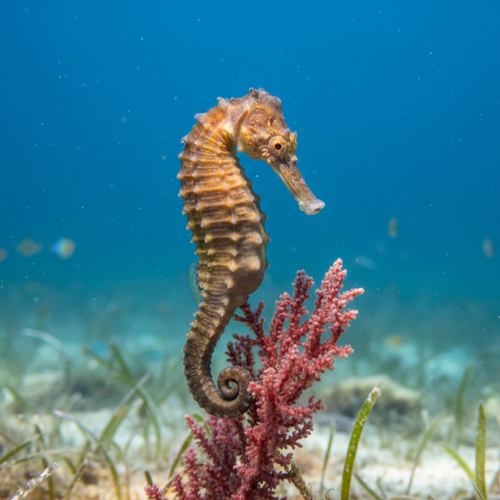
Hippocampus hippocampus has potential to be up to 15 centimetres (5.9 in) long. They have a prominent spine above each eye. They have snouts that are short and upturned. Their snouts are about 1/3 of the length of their head. Their dorsal fin has 16–18 rays with a dark stripe that runs parallel to the margin and provides propulsion. Their pectoral fins have 13–15 rays and are located below the gill openings. Their pectoral fins are mostly utilized for stability and steering. Their angular appearance comes from the bony tubercles that are in the body rings. Their bodies can be black, purple, orange or brown. They have a tail that is unable to bend backwards but is considered semi-flexible. They use it as an anchor by wrapping it around coral or sea grass. The tail is also used to get hold of a partner during greeting and mating services.
Habitat

Hippocampus hippocampus are typically found on the bottoms of rocks, in seaweed or in the edge of sea grass beds in shallow muddy water. They can only be found in waters that are up to 77 metres (253 ft) deep. They have a very restricted home range because they have very limited daily movements. The most of their movement occurs when storms occur and the seahorses are moved with the current or they are carried away because of their grasp on debris that is floating in the water. In the winters they typically move into the deeper water to escape rough seas. They will use their tails to anchor themselves to stems of plants and are able to camouflage very well.

Diet

On average, the adult seahorse will eat roughly between 30 and 50 tiny shrimp a day. Hippocampus hippocampus are known to be ambush predators who feed on live, moving food. They will remain still until a small animal passes within reach and then grab it. They do not have teeth or a stomach, so they use their snout to suck their food straight into their gut. Since the seahorse has no stomach, food passes through its digestive system quickly.

Reproduction

Short snouted seahorses are considered ovoviviparous meaning that the female deposits eggs into a pouch on the male's stomach, called a brood pouch, and the male goes through pregnancy and labour. Sexual maturation occurs during the first reproductive season after birth. The length of the reproductive season can vary based on temperature, light, and water turbulence. Sexual maturity in males is recognized by a brood pouch.

Part of

Where to see it

No dive sites list Short-Snouted Seahorse yet. Explore the map to find sites near you.