
← All marine life
Sea Squirt
Group

Sea Squirt

Ascidiacea, Blainville, 1824

marinefreshwater

About Sea Squirt

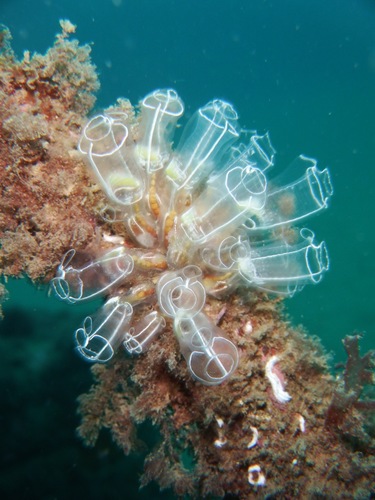
Ascidiacea, commonly known as the ascidians or sea squirts, is a paraphyletic class in the subphylum Tunicata of sac-like marine invertebrate filter feeders. Ascidians are characterized by a tough outer test or "tunic" made of the polysaccharide cellulose.

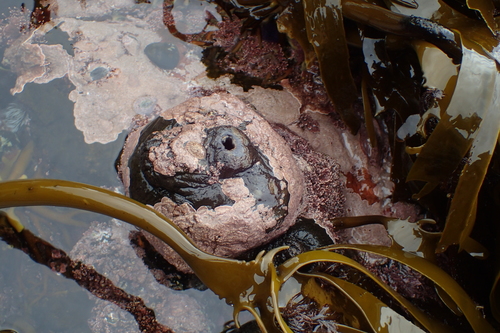
Ascidians are found all over the world, usually in shallow water with salinities over 2.5%. While members of the Thaliacea (salps, doliolids and pyrosomes) and Appendicularia (larvaceans) swim freely like plankton, sea squirts are sessile animals after their larval phase: they then remain firmly attached to their substrate, such as rocks and shells.

There are 2,300 species of ascidians and three main types: solitary ascidians, social ascidians that form clumped communities by attaching at their bases, and compound ascidians that consist of many small individuals (each individual is called a zooid) forming large colonies.

Sea squirts feed by taking in water through a tube, the oral siphon. The water enters the mouth and pharynx, flows through mucus-covered gill slits (also called pharyngeal stigmata) into a water chamber called the atrium, then exits through the atrial siphon.

Some authors now include the thaliaceans in Ascidiacea, making it monophyletic.

Appearance

Sea squirts are rounded or cylindrical animals ranging from about 0.5 to 10 cm (0.20 to 3.94 in) in size. One end of the body is always firmly fixed to rock, coral, or some similar solid surface. The lower surface is pitted or ridged, and in some species has root-like extensions that help the animal grip the surface. The body wall is covered by a smooth thick tunic, which is often quite rigid. The tunic consists of cellulose, along with proteins and calcium salts. Unlike the shells of molluscs, the tunic is composed of living tissue and often has its own blood supply. In some colonial species, the tunics of adjacent individuals are fused into a single structure.
Behaviour

Almost all ascidians are hermaphrodites and conspicuous mature ascidians are sessile. The gonads are located in the abdomen or postabdomen, and include one testis and one ovary, each of which opens via a duct into the cloaca. Broadly speaking, the ascidians can be divided into species which exist as independent animals (the solitary ascidians) and those which are interdependent (the colonial ascidians). Different species of ascidians can have markedly different reproductive strategies, with colonial forms having mixed modes of reproduction.

Reproduction

Different colonial ascidian species produce sexually derived offspring by one of two dispersal strategies – colonial species are either broadcast spawners (long-range dispersal) or philopatric (very short-range dispersal). Broadcast spawners release sperm and ova into the water column and fertilization occurs near to the parent colonies. Some species are also viviparous. Resultant zygotes develop into microscopic larvae that may be carried great distances by oceanic currents. The larvae of sessile forms which survive eventually settle and complete maturation on the substratum- then they may bud asexually to form a colony of zooids.

Species in this group

Where to see it

No dive sites list Sea Squirt yet. Explore the map to find sites near you.