
← All marine life
Sea Lamprey
Species IUCN · Least Concern (LC)

Sea Lamprey

Petromyzon marinus, Linnaeus, 1758

marinebrackishfreshwater

About Sea Lamprey

The sea lamprey (Petromyzon marinus) is a parasitic lamprey native to the Northern Hemisphere. It is sometimes referred to as the "vampire fish".

It was likely introduced to the Great Lakes region through the Erie Canal in 1825 and the Welland Canal in 1919 where it has attacked native fish such as lake trout, lake whitefish, chub, and lake herring. Sea lampreys are considered a pest in the Great Lakes region as each individual has the potential of killing 40 pounds of fish through its 12–18 month feeding period.

Appearance

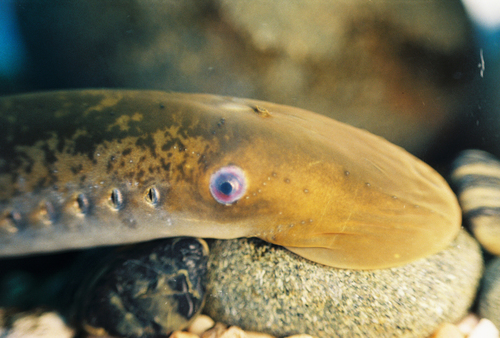
The sea lamprey has an eel-like body without paired fins. Its mouth is jawless, round and sucker-like, and as wide or wider than the head; sharp teeth are arranged in many concentric circular rows around a sharp, rasp-like tongue. There are seven branchial or gill-like openings behind the eye. Sea lampreys are olive or brown-yellow on the dorsal and lateral part of the body, with some black marblings, with lighter coloration on the belly. Within their seven-year lifespans, adults can reach a length of up to 120 cm (47 in) and a body weight up to 2.3 kg (5.1 lb).

Habitat

The species is found in the northern and western Atlantic Ocean along the shores of Europe and North America, in the western Mediterranean Sea, the Black Sea, and as an invasive species in the Great Lakes. They have been found at depths up to 4,000 metres (13,120 ft) and can tolerate temperatures of 1–20 °C (34–68 °F).

In North America, they are native to the Connecticut River basin in the United States, and invasive to the inland Great Lakes and Lake Champlain in New York and Vermont.

The largest European populations of sea lampreys are located throughout the southwestern areas of Europe (north-central Portugal, north-northwest of Spain, and west–southwest of France). These countries also support the main fisheries of the species.

Behaviour

Sea lampreys are anadromous; from their lake or sea habitats, they migrate up rivers to spawn. Females deposit a large number of eggs in nests made by males in the substrate of streams with moderately strong current. Spawning is followed by the death of the adults. Larvae burrow in the sand and silt bottom in quiet water downstream from spawning areas and filter-feed on plankton and detritus.

After several years in freshwater habitats, the larvae undergo a metamorphosis that allows young, post-metamorphic lampreys to migrate to the sea or lakes, and start the adult hematophagous method of feeding. Some individuals start hematophagous feeding in the river before migrating to the sea, where sea lampreys prey on a wide variety of fish.

Where to see it

No dive sites list Sea Lamprey yet. Explore the map to find sites near you.