
← All marine life
Sea Hare
Group

Sea Hare

Aplysiida

marinebrackish

About Sea Hare

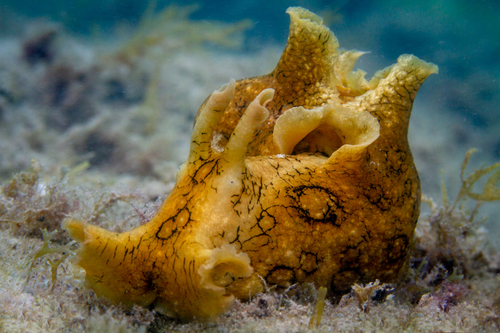
The order Aplysiida, commonly known as sea hares (Aplysia species and related genera), are medium-sized to very large opisthobranch gastropod molluscs with a soft internal shell made of protein. These are marine gastropod molluscs in the superfamilies Aplysioidea and Akeroidea.

The common name "sea hare" is a direct translation from Latin: lepus marinus, as the animal's existence was known in Roman times. The name derives from their rounded shape and from the two long rhinophores that project upward from their heads and that somewhat resemble the ears of a hare.

Appearance

Sea hares are mostly rather large, bulky creatures when adults. Juveniles are mainly unobserved on the shoreline. The biggest species, Aplysia vaccaria, can reach a length of 99 centimetres (39 in) and a weight of 14 kilograms (31 lb) and is arguably the largest gastropod species.

Sea hares have soft bodies with an internal shell, and like all opisthobranch molluscs, they are hermaphroditic. Unlike many other gastropods, they are more or less bilaterally symmetrical in their external appearance. The foot has lateral projections, or "parapodia".

Humans & conservation

Sea hares are consumed in several parts of the world.

In Hawaii, sea hares, or kualakai, are typically cooked in an imu wrapped in ti leaves.

In coastal areas in the Visayas and Mindanao islands in the Philippines, long strands of eggs of the wedge sea hare (Dolabella auricularia, locally known as donsol or dongsul in the Visayan languages) are traditionally eaten. The egg strands are known as lokot or lukot and are harvested from shallow rocks and seagrass meadows. They resemble twisted noodles (pancit) in appearance and texture, hence why they are also called pansit-pansitan ("mock noodles") in some areas. They are usually green, but can be reddish to yellowish in color. They are often mistaken for seaweed and have a taste described as salty and sweet. They are usually eaten raw with vinegar and spices as kinilaw, sauteed like pancit guisado, or added to soups like fish tinola.

Where to see it

No dive sites list Sea Hare yet. Explore the map to find sites near you.