
← All marine life
Schoolmaster Snapper
Species IUCN · Least Concern (LC)

Schoolmaster Snapper

Lutjanus apodus, (Walbaum, 1792)

marinebrackish

About Schoolmaster Snapper

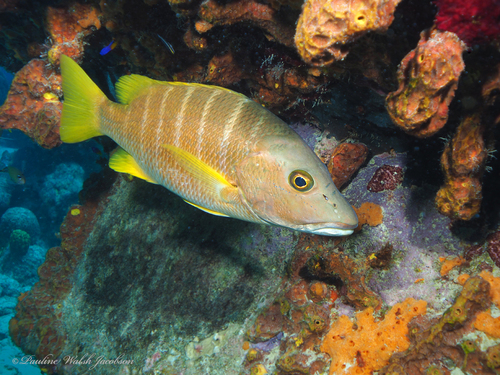
The schoolmaster snapper (Lutjanus apodus), is a species of marine ray-finned fish; a snapper belonging to the family Lutjanidae. It is found in the western Atlantic Ocean, and like other snapper species, it is a popular food fish.

Appearance

The schoolmaster snapper has a moderately deep body which is robust and slightly compressed with a long. pointed snout and a large mouth. One of the upper pairs of canine teeth is clearly larger than back teeth in the lower jaw and can be seen when mouth is closed. The vomerine teeth are arranged in a chevron or crescent shaped patch with a line of similar teeth extending from the middle of the patch towards the rear. The preoperculum has a weakly developed incision and knob. This species has a protrusible upper jaw which is mostly covered by the cheek bone when the mouth is closed and both pairs of nostrils are simple holes. The dorsal fin is continuous with a slight incision separating the spiny part from the soft rayed part. The dorsal fin has 10 spines and 14 soft rays while the rounded anal fin contains 3 spines and 8 soft rays.
Habitat

The schoolmaster snapper is found in the western Atlantic Bermuda and the southeastern coast of the United States from Cape Canaveral in Florida southwards to the Bahamas and into the Gulf of Mexico where its range runs from the Florida Keys as far north as Tampa, Florida then from Alabama westwards along the coast of the Gulf to the Yucatan Peninsula and northwestern Cuba. It occurs throughout the Caribbean Sea. It has been recorded as far north as Massachusetts but these records involve juveniles that cannot survive the winter. It is typically found at depths between 1 and 50 m (3 ft 3 in and 164 ft 1 in), with one record at 89 m (292 ft). Adults usually stay near shore shelter around elkhorn and gorgonian coral. Large adults are sometimes found on the continental shelf. Typical depths are up to 4 m (13 ft).

Diet

Studies have reported that the diet of the schoolmaster snapper changes ontogenetically, small individuals, less than 70 mm (2.8 in) in length have a 90% of their diet made up of crustaceans, specifically amphipods and crabs. Larger specimens preferred smaller fish. these making up more than 50% of their diet by weight, and also ate crabs, shrimp, and stomatopods. These differences in diets were attributed to the ability of the bigger fish to open their jaws wider for bigger prey.

Reproduction

Schoolmaster snapper are gonochorist, meaning males and females are separate. They spawn over most of the year, with the majority of the spawning happening during middle to late summer. They spawn during April–June off Cuba. They reproduce by spawning in open water with both male and female fish releasing their gametes at the same time. The fertilized eggs then settle to the bottom, where they are left unguarded.

The schoolmaster snapper is a slow growing, long lived species which has a maximum recorded age of 42 years.

As fish grow longer, they increase in weight, but the relationship is not linear. The relationship between length (L) and weight (W) for nearly all species of fish can be expressed by an equation of the form:

Humans & conservation

The IUCN lists this species as being of Least Concern because it is not routinely targeted by commercial fisheries and separate commercial catch statistics are unavailable. The juveniles are common in mangroves and on shallow reefs which may be threatened by coastal development, as well as the impacts of climate change. In Colombia, illegal dynamite fishing in the Rosario Islands led to the near extirpation of this species. In some areas, minimum sizes and bag limits have been introduced to conserve the stocks of schoolmaster snapper. Fishing pressure could lead to a decrease in numbers and make the defensive aggregations of these fish more vulnerable to predation, so it has been suggested that no-take zones be introduced to reduce the amount of fishes killed by fisheries.

Part of

Where to see it

No dive sites list Schoolmaster Snapper yet. Explore the map to find sites near you.