
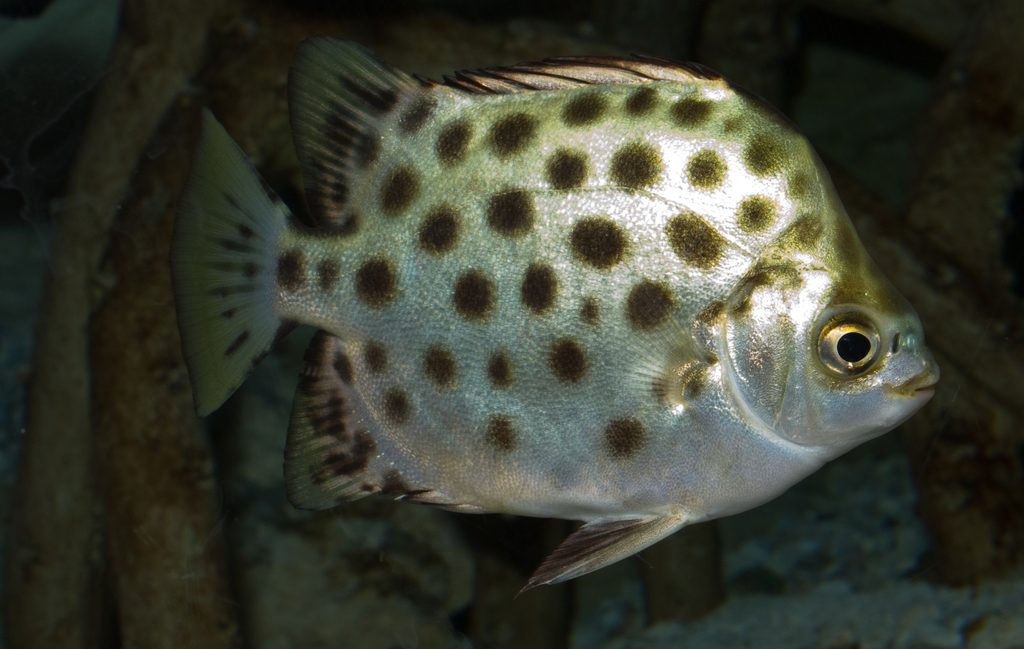
Appearance
Scatophagidae fishes, the scats, have highly compressed, oblong bodies. The dorsal profile of the head rises steeply to the nape, they have a rounded snout, as is the space between the eyes. The small mouth is horizontal, and cannot be protruded, and has several rows of small bristle-like teeth on the jaws. There are no teeth on the roof of the mouth. The dorsal fin has 11–12 robust spines and 16–18 soft rays, the first spine lies flat and there is a deep incision between the spiny and soft-rayed parts of the fin. The anal fin has 4 robust spines and 13–16 soft rays and the relatively small pectoral fins have 16–17 rays. The caudal fin may be truncate or weakly emarginate. although it is rounded in juveniles. The head and the body are covered with tiny ctenoid scales and these reach the soft rayed parts of the dorsal and anal fins.