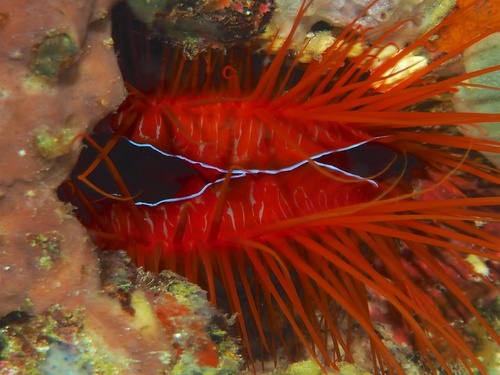
Appearance
Very little variation occurs in the internal arrangement of organs and systems within the scallop family, and what follows can be taken to apply to the anatomy of any given scallop species.

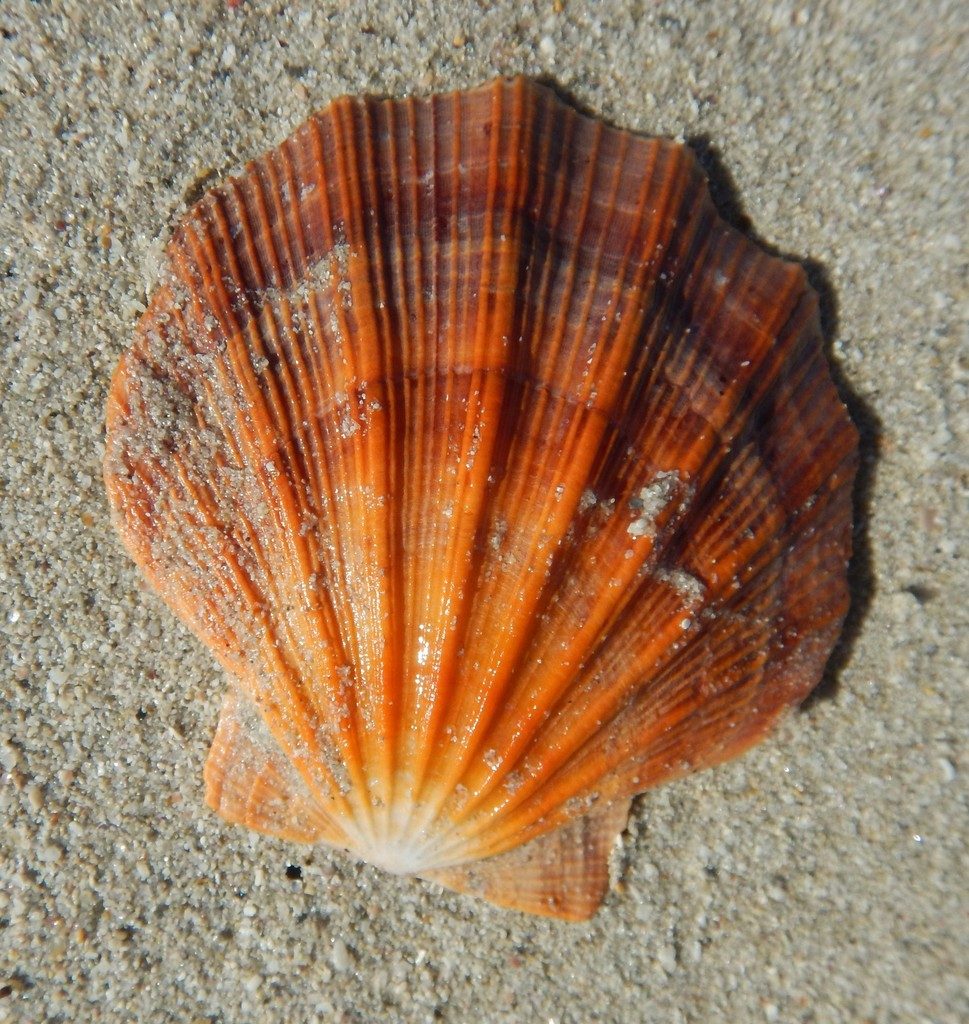
Pectinidae, Rafinesque, 1815
Scallop is a common name that encompasses various species of marine bivalve molluscs in the taxonomic family Pectinidae, the scallops. However, this common name is also sometimes applied to species in other closely related families within the superfamily Pectinoidea, which also includes the thorny oysters.
Scallops are a cosmopolitan family of bivalves found in all of the world's oceans, although never in fresh water. They are one of very few groups of bivalves to be primarily "free-living", with many species capable of rapidly swimming short distances and even migrating some distance across the ocean floor. A small minority of scallop species live cemented to rocky substrates as adults, while others attach themselves to stationary or rooted objects such as seagrass at some point in their lives by means of a filament they secrete called a byssal thread.
The majority of scallop species, however, live recumbent on sandy substrates, though when they sense the presence of a predator such as a starfish, they may attempt to escape by swimming swiftly but erratically through the water using jet propulsion created by repeatedly clapping their shells together. Scallops have a well-developed nervous system, and unlike most other bivalves all scallops have a ring of numerous simple eyes situated around the edge of their mantles.
Very little variation occurs in the internal arrangement of organs and systems within the scallop family, and what follows can be taken to apply to the anatomy of any given scallop species.
Scallops inhabit all the oceans of the world, with the largest number of species living in the Indo-Pacific region. Most species live in relatively shallow waters from the low tide line to 100 m, while others prefer much deeper water. Although some species only live in very narrow environments, most are opportunistic and can live under a wide variety of conditions. Scallops can be found living within, upon, or under either rocks, coral, rubble, sea grass, kelp, sand, or mud. Most scallops begin their lives as byssally attached juveniles, an ability that some retain throughout their lives while others grow into free-living adults.
Scallops are characterized by offering two flavors and textures in one shell: the meat, called "scallop", which is firm and white, and the roe, called "coral", which is soft and often brightly coloured reddish-orange. Sometimes, markets sell scallops already prepared in the shell, with only the meat remaining. Outside the U.S., the scallop is often sold whole. They are available both with and without coral in the UK and Australia.
Scallops without any additives are called "dry-packed", while scallops that are treated with sodium tripolyphosphate (STPP) are called "wet-packed". STPP causes the scallops to absorb moisture prior to the freezing process, thereby increasing their weight. The freezing process takes about two days.
Most species of the scallop family are free-living, active swimmers, propelling themselves through the water through the adductor muscles to open and close their shells. Swimming occurs through the clapping of valves for water intake. Closing the valves propels water with a strong force near the hinge via the velum, a curtain-like fold of the mantle that directs water expulsion around the hinge. Scallops swim in the direction of the shell opening unless the velum directs an abrupt change in course direction.
The term "scalloped" is used to designate a decorative pattern, resembling the wavy scallop surface, that is used at the edges of furniture, fabrics, and other items.
No dive sites list Scallop yet. Explore the map to find sites near you.