
← All marine life
Sarcastic Fringehead
Species IUCN · Least Concern (LC)

Sarcastic Fringehead

Neoclinus blanchardi, Girard, 1858

marine

About Sarcastic Fringehead

The sarcastic fringehead (Neoclinus blanchardi) is a small saltwater tube-blenny that possesses an extremely large, brightly coloured mouth, which males display during territorial encounters, for which it has been given its common name. The term 'fringehead' reflects the distinctive ruff of tissue surrounding the fish's neck. The specific name honors Dr. S. B. Blanchard of San Diego, California, who collected specimens of this blenny and passed them on to Charles Frédéric Girard, who described it.

Appearance

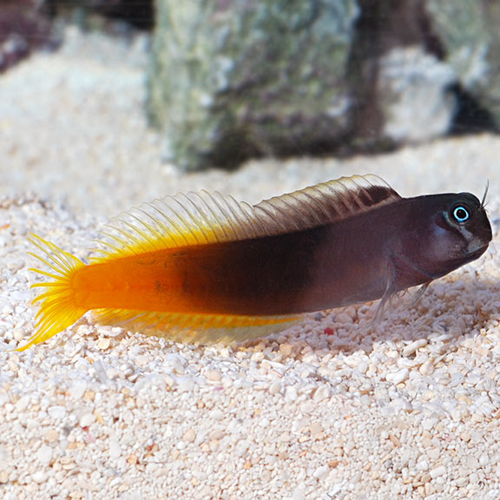
Sarcastic fringeheads can be up to 30 centimetres (12 in) long, and are mostly scaleless with great pectoral fins and reduced pelvic fins. Usually there are pale spots or patches on the cheeks. Males have a series of eye‑like markings on the spiny portion of the dorsal fin; each spot shows a vivid metallic blue centre bordered by a golden yellowish ring. The swimming movements of these fish mainly consist of short, dart-like movements. Their body coloration varies from warm brown to gray with a blotchy appearance.

Male sarcastic fringeheads are distinguished by their extremely wide mouth gape, which, when open, may be as much as four times its size when closed. The interior of the mouth is brightly colored, with yellow at the posterior, which is hypothesized to amplify its display. Additionally, the buccopalatal membranes exhibit green fluorescence.
Habitat

Due to the size of their mouths, sarcastic fringeheads are categorized as ram-suction feeders, relying on fast burst speeds and moderate suction to capture prey. During squid spawning season, they can consume large numbers of squid eggs. Outside of that, they mainly feed on crustaceans and planktonic prey. They modulate their gape size during feeding, using only half of their maximum mouth opening to eat. Variability in daily foraging time, influenced by the frequency of territorial encounters, may shape evolutionary adaptations in fringeheads, including gut size and efficiency based on food availability.

Behaviour

Sarcastic fringeheads live along sandy and muddy bottoms below the low tide line. They tend to back into objects and cavities, such shells, burrows, and crevices, exposing only their heads. They are also found living in man-made objects, such as bottles and soda cans.

Reproduction

The female spawns roughly 3,000 eggs under a rock, in clam burrows, or in other containers, after which the male plays a crucial role in guarding and fanning the eggs until they hatch. The eggs have a diameter of approximately 0.9 to 1.5 millimetres (0.035 to 0.059 in), and their filaments help them adhere to the nest and to one another. Upon hatching, the larvae measure approximately 3 millimetres (0.12 in) in length. Sarcastic fringeheads spawn between January and August at depths ranging from 45 to 90 feet (14 to 27 m). The genital papilla, located at the rear of the urogenital opening, differs between sexes: males have a pointed papilla, while females have a rounded one. Sarcastic fringeheads can live up to a maximum of about 6 years, which contributes to their reproductive strategies.

Humans & conservation

The sarcastic fringehead is classified as 'Least Concern' by the IUCN due to relatively low threats from human activities and its occurrence in areas that are protected. Despite their small size, sarcastic fringeheads are unlikely to be targeted by fishers due to their aggressive nature. When they are caught accidentally, sport and commercial anglers often find them challenging to handle due to the likelihood of being bitten by the needle-like teeth when they become agitated. Divers have noted that these fish can damage their wetsuits.

Part of

Where to see it

No dive sites list Sarcastic Fringehead yet. Explore the map to find sites near you.