
← All marine life
Sandfish
Group IUCN · Endangered (EN)

Sandfish

Holothuria scabra, Jaeger, 1833

marine

About Sandfish

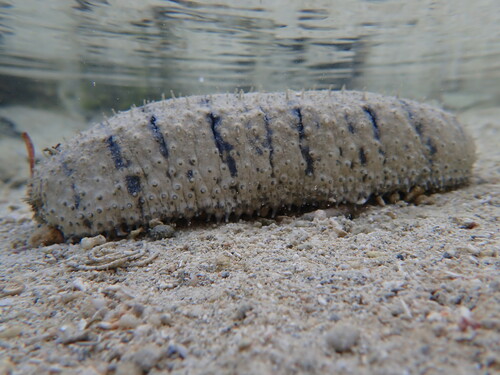
Holothuria scabra, or sandfish, is a species of sea cucumber in the family Holothuriidae. It was placed in the subgenus Metriatyla by Rowe in 1969 and is the type species of the subgenus. Sandfish are harvested and processed into "beche-de-mer" and eaten in China and other Pacific coastal communities.

Sea cucumbers are marine invertebrates and are closely related to sea urchins and starfish. All these groups tend to have radial symmetry and have a water vascular system that operates by hydrostatic pressure, enabling them to move around by use of many suckers known as tube feet. Sea cucumbers are usually leathery, gherkin-shaped animals with a cluster of feeding tentacles at one end surrounding the mouth.

Appearance

The sandfish has the same basic anatomy as most other species of sea cucumber. Their bodies are elongated and cylindric, and relatively stubby. Their dorsal side can range in color from a grey-brown to black, with darkened wrinkles across the body and small black papillae from end to end. They are counter shaded with a lighter ventral side, which is relatively flat. They have a mouth located on the ventral surface at one end of the body, considered the front end. Like other sea cucumbers, they use feeding tentacles which protrude from the mouth. Sandfish have around 20 short tentacles. On the opposite end the anus is found on the dorsal side. They can grow up to an average length of 22 cm with the largest reaching up to 40 cm, and reach maturity around 16 cm or 200 grams with some growing as much as 300 grams in one year.

Habitat

The sandfish inhabits shallow tropical waters, <20 m deep. They prefer seagrass meadows and muddy bottomed substrata with high nutrient levels due to their diet preference. They do have a tolerance for lowered salinity, down to 20 ppt, such as that found in brackish water. Sandfish play a key role in the health of their habitat; like most sea cucumbers H. scabra are bioturbators and play a key role in reworking the sediment and ensuring that organic matter is evenly distributed for the ecosystem to function, and have a subsequent diet of detritus and other microorganisms.

Diet

The sandfish has been eaten by man for over 1000 years. About twenty other species of sea cucumber are also consumed but the sandfish is the species most often used. In the 1990s it was being sold dried as beche-de-mer for up to US$100 per kilogram. Harvesting sandfish from the sea is known as trepanging in Indonesia. In many areas the fisheries have declined over the years because of over fishing, so ranching, aquaculture and hatchery rearing are being attempted.

Behaviour

The species can be found in the Indo-Pacific region, from east Africa to the eastern Pacific. Some have been found in the Persian Gulf, Iran. They are typically restricted to latitudes between 30° N to 30° S, due to it being a tropical species.

Reproduction

The sandfish goes through 6 stages of growth before maturing into an adult. This starts when the adults spawn. After a day the fertilized eggs develop into a first planktonic phase, a gastrula, then after two days it becomes an auricularia, the feeding planktonic stage. Within the next 14 days the sandfish will enter a non-feeding doliolaria stage and a final planktonic pentactula stage, before becoming juveniles and settling into the sea grass meadows to mature.

Humans & conservation

The sandfish is listed as an endangered with populations declining by the IUCN Red List. They face threats from over harvesting, but efforts are currently being taken around the Indo-Pacific including bans on the fishery and restocking via aquaculture efforts.

Where to see it

No dive sites list Sandfish yet. Explore the map to find sites near you.