
← All marine life
Sand Dab
Species IUCN · Least Concern (LC)

Sand Dab

Limanda limanda, (Linnaeus, 1758)

marine

About Sand Dab

The common dab (Limanda limanda) is an edible flatfish of the family Pleuronectidae. It is a demersal fish native to shallow seas around Northern Europe, in particular the North Sea, where it lives on sandy bottoms down to depths of about 100 metres (330 ft). It can reach 40 centimetres (16 in) in length and can weigh up to 1 kilogram (2.2 lb), though most specimens grow no longer than 20 centimetres (7.9 in).

Appearance

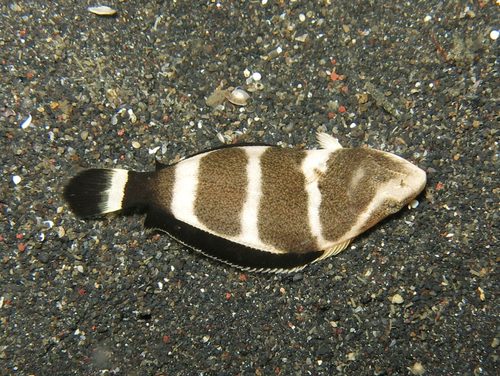
The common dab has a similar appearance to both the plaice and the flounder, and similarly has both its eyes normally on the right-hand side of its body. The upper surface is usually pale brown in colour with scattered darker blotches and speckles, but does not have the orange spots typical of a plaice. They are distinguished from flounder by their translucent body. The pectoral fins may be orange. The lateral line is marked by a distinctive semi-circular curve above the pectoral fin. The dorsal and anal fins form a gently rounded curve round the margin of the body. The scales have rough posterior edges and this fish has no large bony projections. A typical size is in the range 25 to 40 cm (10 to 16 in).
Habitat

The common dab is a bottom dweller, found in coastal waters in the northeastern Atlantic Ocean. Its range extends from the Bay of Biscay to Iceland and the White Sea and includes the North Sea and the western part of the Baltic Sea.

Diet

The common dab's diet consists of zoobenthos organisms such as marine worms, molluscs, sand eels, amphipods, crustaceans, echinoderms and smaller fishes.

Part of

Where to see it

No dive sites list Sand Dab yet. Explore the map to find sites near you.