
← All marine life
Salp
Group

Salp

Salpidae, Lahille, 1888

marine

About Salp

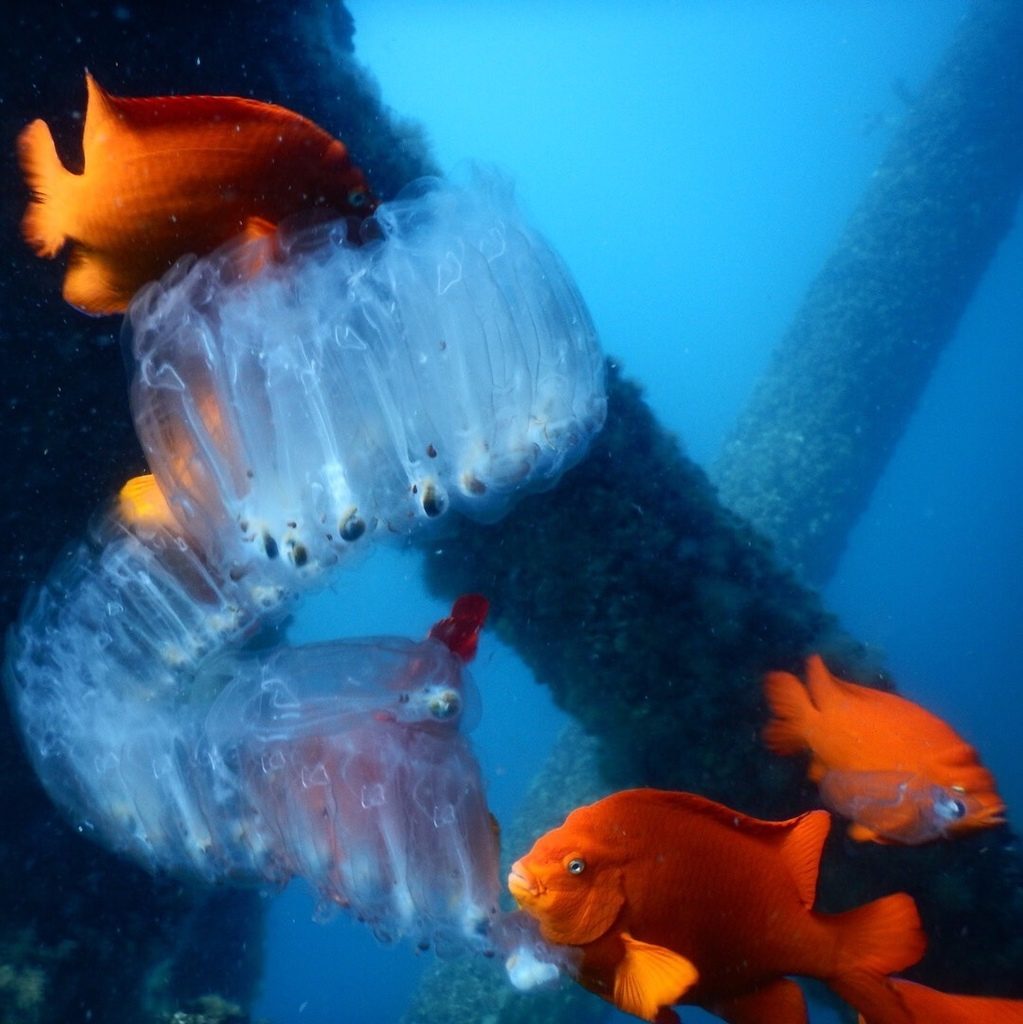
A salp (pl.: salps) or salpa (pl.: salpae or salpas) is a barrel-shaped, planktonic tunicate in the family Salpidae. The salp moves by contracting its gelatinous body in order to pump water through it; it is one of the most efficient examples of jet propulsion in the animal kingdom. The salp feeds on phytoplankton, which it collects by straining water through its internal feeding filters.

Habitat

Salps are common in equatorial, temperate, and cold seas, where they can be seen at the surface, singly or in long, stringy colonies. The most abundant concentrations of salps are in the Southern Ocean (near Antarctica), where they sometimes form enormous swarms, often in deep water, and are sometimes even more abundant than krill. Since 1910, while krill populations in the Southern Ocean have declined, salp populations appear to be increasing. Salps have been seen in increasing numbers along the coast of Washington, United States.

Reproduction

Salps have a complex life cycle, with an obligatory alternation of generations. Both portions of the life cycle exist together in the seas—they look quite different, but both are mostly transparent, tubular, gelatinous animals that are typically between 1 and 10 cm (0.4 and 3.9 in) long. The solitary life history phase, also known as an oozooid, is a single, barrel-shaped animal that reproduces asexually by producing a chain of tens to hundreds of individuals, which are released from the parent at a small size.

Where to see it

No dive sites list Salp yet. Explore the map to find sites near you.