
← All marine life
Salmon Shark
Species IUCN · Least Concern (LC)

Salmon Shark

Lamna ditropis, Hubbs & Follett, 1947

marine

About Salmon Shark

The salmon shark (Lamna ditropis) is a species of mackerel shark found in the northern Pacific ocean. Similar to other mackerel sharks, salmon sharks have a thunniform body type. As an apex predator, the salmon shark feeds on salmon, squid, sablefish, birds, walleye pollock, and herring. Salmon sharks get their name from their diet, which primarily consists of salmon. It is known for its ability to maintain stomach temperature (homeothermy), which is unusual among fish. It is also known for an unexplained variability in the sex ratio between eastern and western populations in the northern Pacific.

Appearance

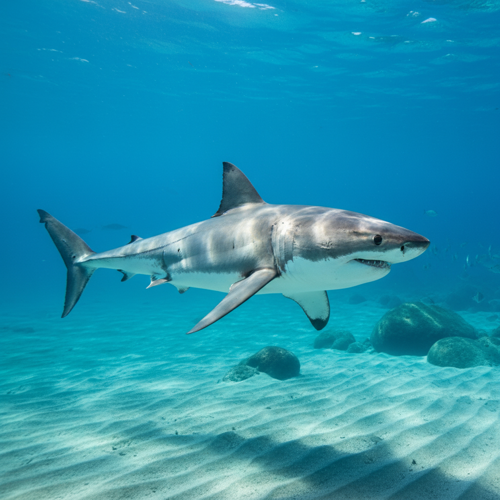
Adult salmon sharks are medium grey to black over most of the body, with a white underside with darker blotches. Juveniles are similar in appearance, but generally lack blotches. The snout is short and cone-shaped, and the overall appearance is similar to a small great white shark. The eyes are positioned well forward, enabling binocular vision to accurately locate prey.

The salmon shark generally grows to between 200 and 260 cm (6.6–8.6 ft) in length and weighs up to 220 kg (485 lb). Males appear to reach a maximum size slightly smaller than females. Unconfirmed reports exist of salmon sharks reaching as much as 4.3 m (14.2 ft); however, the largest confirmed reports indicate a maximum total length of about 3.0 m (10 ft). The claims of maximum reported weight over 450 kg (992 lb) are "unsubstantiated".
Habitat

North of the equator, in the northern Pacific Ocean, the salmon shark is relatively common in continental offshore waters, where it ranges from inshore to just off the coast. Tagging has revealed a range which includes sub-Arctic to subtropical waters. The species is believed to range as far south as the Sea of Japan and as far north as 65°N in Alaska, notably appearing en masse in Prince William Sound during the annual salmon run. Individuals have been observed diving as deep as 668 m (2,192 ft), but they are believed to spend most of their time in epipelagic waters. While salmon sharks primarily travel alone, or in feeding aggregations of several individuals, sometimes they may be seen in schools.

Humans & conservation

Currently, no commercial fishery for salmon shark exists, but they are occasionally caught as bycatch in commercial salmon gillnet fisheries, where they are usually discarded. Commercial fisheries regard salmon sharks as nuisances since they can damage fishing gear and consume portions of the commercial catch. Fishermen deliberately injuring salmon sharks have been reported.

Sport fishermen fish for salmon sharks in Alaska. Alaskan fishing regulations limit the catch of salmon sharks to two per person per year. Sport fishermen are allowed one salmon shark per day from April 1 and ending the following March 31 in British Columbia.

The flesh of the fish is used for human consumption, and in the Japanese city of Kesennuma, Miyagi, the heart is considered a delicacy for use in sashimi.

Part of

Where to see it

No dive sites list Salmon Shark yet. Explore the map to find sites near you.