
← All marine life
Saddletail Snapper
Species IUCN · Least Concern (LC)

Saddletail Snapper

Lutjanus malabaricus, (Bloch & Schneider, 1801)

marinebrackish

About Saddletail Snapper

Lutjanus malabaricus, the Malabar blood snapper, saddletail snapper, large-mouthed nannygai, large-mouthed sea-perch, Malabar snapper, nannygai, red bass, red bream, red emperor, red Jew, red snapper, saddletail seaperch, scarlet emperor or scarlet sea-perch, is a species of marine ray-finned fish, a snapper belonging to the family Lutjanidae. It is native to the Indian Ocean and the western Pacific, where it is found east to Fiji and Japan.

Appearance

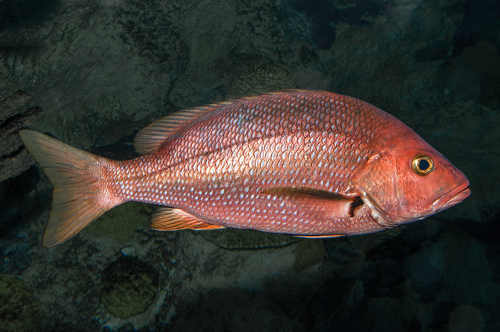
Lutjanus malabaricus has a relatively deep body, which has a standard length that is 2.2 to 2.8 times as long as the body at its deepest point. It has a steeply sloped forehead, with a concave upper profile to the snout, and the preopercular incision and knob are weakly developed. The vomerine teeth are arranged in a crescent shaped or triangular patch with no central rearwards extension, and there are no teeth on the tongue. The dorsal fin has 11 spines and 12-14 soft rays, while the anal fin contains 3 spines and 8-9 soft rays. The rear of the dorsal fin and the anal fin may have an angular profile or be weakly rounded, the pectoral fins have 16–17 rays and the caudal fin is truncate. This fish attains a maximum total length of 100 cm (39 in), although 50 cm (20 in) is more typical, with a maximum published weight of 7.9 kg (17 lb).
Habitat

Lutjanus malabaricus has a wide range in the Indo-West Pacific to the Persian Gulf east to Fiji, from southern Japan south to Australia. It has also been confirmed to occur in Tonga and Kosrae and at Jeju Island in South Korea. There are also unconfirmed reports from Eastern Africa. In Australia, its range extends from Shark Bay in Western Australia along the western, northern and eastern coasts, extending as far south as Sydney. Adults occur in coastal and offshore reefs, frequently being encountered around sponges and gorgonian corals, or in areas of hard muddy bottom. The juveniles show a preference for shallow waters close to shore, while the adults prefer deeper areas.

Humans & conservation

Lutjanus malabaricus is considered to be a high quality food fish and is pursued by commercial, artisanal and recreational fisheries throughout its range. It is considered to be overfished in many areas such as the Persian Gulf and Indonesia. It is caught using trawls, although handlines and bottom longlines are also used. Some of the fish landed are exported to international markets. In southern China, this species is grown in mariculture. Although it has been overfished and the population has declined in some areas in others, such as Australia, fishing is strictly regulated, and populations are stable so the IUCN has assessed the species as Least Concern.

Part of

Where to see it

No dive sites list Saddletail Snapper yet. Explore the map to find sites near you.