
← All marine life
Rusty Crayfish
Species IUCN · Least Concern (LC)

Rusty Crayfish

Faxonius rusticus, (Girard, 1852)

freshwater

About Rusty Crayfish

The rusty crayfish (Faxonius rusticus) is a large, aggressive species of freshwater crayfish which is native to the United States, in the Ohio River Basin in parts of Ohio, Kentucky, and Indiana. Its range is rapidly expanding across much of eastern North America, displacing native crayfishes in the process. The rusty crayfish was first captured in Illinois in 1973, and has been collected at over 20 locations in the northern portion of the state. In 2005, F. rusticus was found for the first time west of the Continental Divide, in the John Day River, Oregon, which runs into the Columbia River.

Appearance

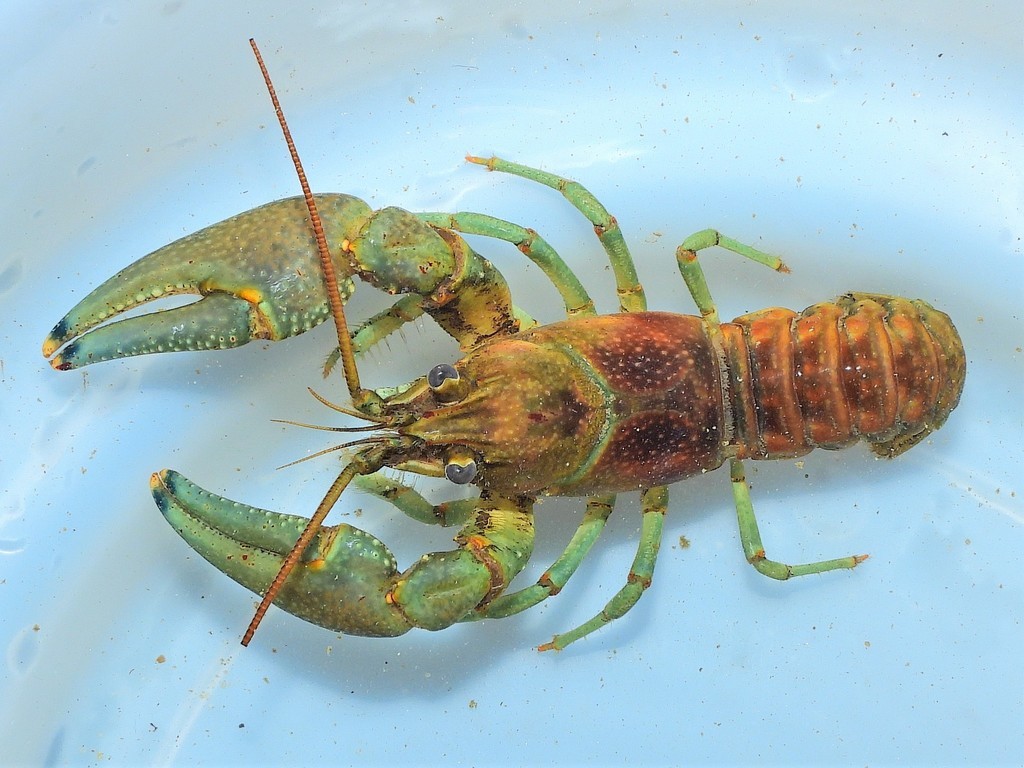
Adult rusty crayfish can reach 10 centimeters (4 inches) in length, although they reach maturity at about 4.4 cm (1.7 in), and can range in color from greenish grey, to reddish brown, They can be recognized by two "rusty", reddish colored spots variably present on the sides of their posterior carapace and their large front claws with black bands around the tips. Male astacoid crayfish have small hook-like features, or copulatory stylets, that are used to hold onto a female while mating, prominent in rusty crayfish on the ischia of the third pair of pereopods for those males in their form I (reproductive) molt.

Behaviour

Many species of vertebrates that live in communities together utilize a dominance hierarchy to establish order, and studies have shown that some species of invertebrates do as well. The dominance hierarchy is an important aspect of a crayfish's biology and behavior. Crayfish tend to form dominance hierarchies with the other members of their population in a particular environment. The largest male will generally demonstrate the most dominance over the others by being the most aggressive, and picking fights with the other, smaller crayfish. The crayfish that wins the most fights is placed at the top of the hierarchy with the other members generally ranking in descending order based on size and sex. Studies have suggested that the largest determining factor in the formation of dominance hierarchies is size rather than sex.

Where to see it

No dive sites list Rusty Crayfish yet. Explore the map to find sites near you.