
← All marine life
Royal Angelfish
Species IUCN · Least Concern (LC)

Royal Angelfish

Pygoplites diacanthus, (Boddaert, 1772)

marine

About Royal Angelfish

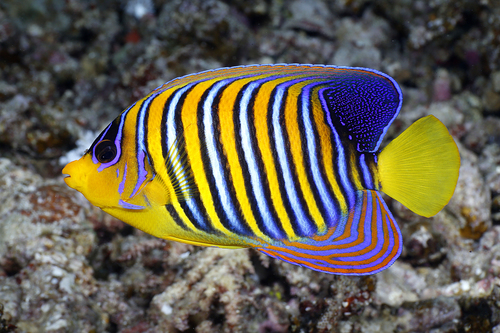
The royal angelfish (Pygoplites diacanthus), or regal angelfish, is a species of marine ray-finned fish, a marine angelfish belonging to the family Pomacanthidae, and the monotypic genus Pygoplites. It is found in tropical Indo-Pacific oceans. It can grow as long as 25 cm (9.8 in).

Appearance

The body of the royal angelfish is moderately elongate and is very compressed. The preorbital bone is convex and has no strong spines. There is 1 prominent spine at an angle at the preopercal. The ventral edge of the interopercle is smooth. The eyes are moderately small along with the mouth that is terminal. The mouth is also protractile. They have a maximum length of 25.0 cm (9.8 in). They have a total of 14 dorsal spines, and 17–19 soft dorsal rays. They have 3 anal spines and 17–19 anal soft rays. They also have 16–17 pectoral fin rays. Their caudal fin is rounded. The precise coloration of this fish can vary as regional differences can occur, most notably in populations from the Indian Ocean, Red Sea, and South Pacific Ocean. A commonality, however, is a body edged in narrow blue-white and orange stripes that are narrow and angle backward.
Habitat

The royal angelfish is widely distributed throughout the Indo-Pacific. The species can be found in the Red Sea and Indian Ocean around East Africa and the Maldives, stretching to the Tuamoto Islands, New Caledonia, and Great Barrier Reef. The northernmost limits of its range ends in the southern East China Sea around Taiwan and the Ryukyu Islands and Ogasawara Islands of Japan.

Behaviour

The royal angelfish occurs at depths ranging from 0 to 80 m (0 to 262 ft), in coral rich areas of lagoons, reefs, and are also often found in the vicinity of caves. It is a carnivorous species that feeds on sponges and tunicates located throughout reefs and underwater caves. They are a non-migratory species that can be found solitary, in pairs, or groups. The juveniles usually shelter in cracks and crevices.

Reproduction

Royal angelfish reproduce by spawning, spawning usually happens at dusk or at night. They then act in a spiraling dance before the eggs and sperm are released into the upper water column.

Humans & conservation

The royal angelfish is considered to be harmless to humans, and has minor commercial use in the aquarium industry. It is valued by aquarium hobbyists for being one of the few "reef safe" angelfish as its diet is composed primarily of sponges, and does not include corals.

Part of

Where to see it

No dive sites list Royal Angelfish yet. Explore the map to find sites near you.