
← All marine life
Roosterfish
Group

Roosterfish

Nematistiidae, Gill, 1862

marine

About Roosterfish

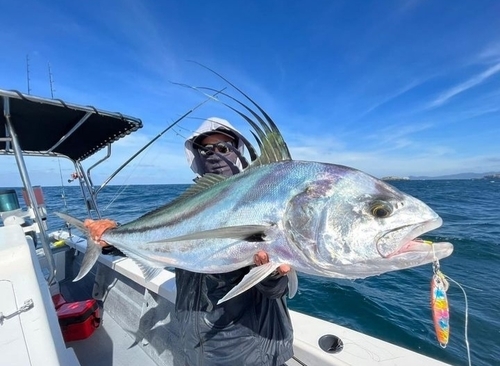
The roosterfish (Nematistius pectoralis) is a unique species of marine carangiform fish found in the warmer shallow waters of the southeastern Pacific Ocean, from Baja California south to Peru. Roosterfish are a popular sport fish for being strong fighters. They are also important targets of local artisanal and subsistence fisheries. It is the only species in the genus Nematistius, the family Nematistiidae, and the suborder Nematistioidei. Their name comes from them having a "rooster comb" or seven long spines on the dorsal fin. Roosterfish can reach over 1.6 m (5 ft 3 in) in length and over 50 kg (110 lb) in weight.

Appearance

The body form of roosterfish is elongate and fusiform in shape. They have wide bands of simple teeth lining the inside of their pointed head. Their dorsal fin always has seven spines and a separate section of 25 soft rays, the anal fin has two spines and 15 soft rays, the pectoral fin has 16 soft rays that are very long and curved. The caudal fin is deeply forked. Silvery reflective and bluish to gray in color on head and body. They have four black bars, one runs between their eyes, another across the back part of the head, two begin at the dorsal fin and curve along the length of the body back towards the tail. The ridge of their spine also has some darker coloration. A large black patch is apparent on the lower base of the pectoral fins. The spines of their dorsal fin are yellowish gray and black towards the tip.
Habitat

The native range of roosterfish is nearshore flats in the Pacific Ocean. The northern extent of their range is the Pacific Ocean and the Gulf of California surrounding the Baja Peninsula. They are present along the coast of Central America to Peru in South America and in the Galapagos archipelago and Malpelo Island.

Diet

Roosterfish are generalist predators and eat many different things. They are important pelagic predators in the coastal regions where they occur. The results of analyzing the stomach contents of multiple roosterfish showed nine species of prey fish and one cephalopod. The most common prey item in the stomachs of the roosterfish was anchovies of the genus Anchoa. Roosterfish are known to feed in shallow lagoons and along shallow beaches. Roosterfish follow prey species to maintain high nutritional content throughout the year.

Reproduction

There are few studies on the spawning habits of roosterfish. They typically spawn during the warmer months, but this varies across their range. During the spawning season roosterfish gather in large groups called spawning congregations. While they migrate the perform courtship rituals. Roosterfish are ovuliparous meaning they exhibit external fertilization where the sperm and eggs are shed directly into the water. When the eggs hatch the fry are transparent. At this stage of their life they are very vulnerable to predation. The juvenile fish roosterfish are characterized by black bands that run vertically on their bodies and the majority of their body is silver. Juveniles tend to live in shallow waters close to the coast where there is a surplus of food and protection from predation. This behavior helps them to facilitate growth. Sexual maturity is reached at age 4+.

Humans & conservation

The International Union for Conservation of Nature (IUCN) had roosterfish listed as globally data deficient until 2024 when they were classified as Least Concern. There are several efforts to increase global knowledge about roosterfish, notably efforts by the International Game Fish Association to fund roosterfish research.

Species in this group

Where to see it

No dive sites list Roosterfish yet. Explore the map to find sites near you.