
← All marine life
Roman Seabream
Species IUCN · Least Concern (LC)

Roman Seabream

Chrysoblephus laticeps, (Valenciennes, 1830)

marine

About Roman Seabream

Chrysoblephus laticeps, the red roman or roman seabream, is a species of marine ray-finned fish belonging to the family Sparidae, the seabreams and porgies. This fish is endemic to Southern Africa, ranging from Namibia to the Eastern Cape.

Appearance

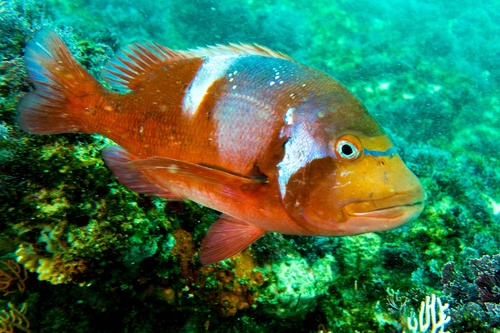
Chrysoblephus laticeps has amore ovate body than other Chrysoblephus sea breams, the depth of the body fitting into its standard length between 2.3 and 2.5 times. The dorsal profile of the head slopes gently from the origin of the dorsal fin to the snout, as the fish ages the area in front of the eyes becomes concave. The area between the eyes is wide and also concave. This is a colourful species with the head, body and fins being vivid orange. There is a blue bar between the eyes and a white saddle-like mark on the back below the 7th to 9th spines in the dorsal fin. The dorsal fin is supported by 11 or 12 spines and 10 or 11 soft rays while the anal fin contains 3 spines and between 7 and 9 soft rays. The roman has a maximum published total length of 50 cm (20 in), although 32 cm (13 in) is more typical.

Habitat

Chrysoblephus laticeps is endemic to the waters off Southern Africa in the southeastern Atlantic Ocean and southwestern Indian Ocean from northern Namibia to Durban in KwaZulu-Natal. Records from southern Madagascar and Mauritious are considered to be dubious. It is found at depths between 0 and 100 m (0 and 328 ft) on inshore and offshore reefs with elevated topography in deep water.

Humans & conservation

Crysoblephus laticeps is sought after by line fishers, operating from the shore or from boats within the inshore zone. Linefishing is the least destructive fishing method, having little impact when carried out with rod and reel or a handline. Other methods, such as spearfishing, lead to overfishing and a population decline in areas such as Port Elizabeth and False Bay. Its slow growth renders the species particularly vulnerable. There is evidence of some recovery of numbers within Marine Protected Areas.

Part of

Where to see it

No dive sites list Roman Seabream yet. Explore the map to find sites near you.