← All marine life
Rock Beauty
Species IUCN · Least Concern (LC)

Rock Beauty

Holacanthus tricolor, (Bloch, 1795)

marine

About Rock Beauty

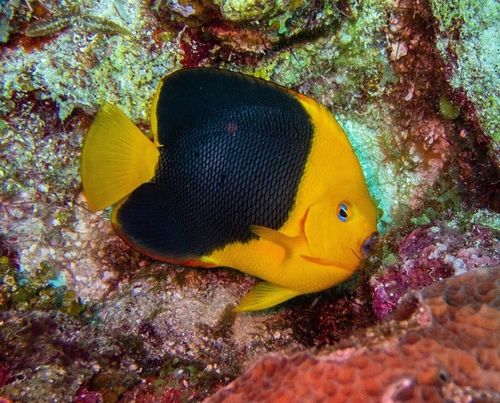
The rock beauty (Holacanthus tricolor), also known as corn sugar, coshubba, rock beasty, catalineta or yellow nanny, is a species of marine ray-finned fish in the angelfish family Pomacanthidae. It is found in the western Atlantic Ocean.

Appearance

The rock beauty has a deep, oval and strongly compressed body, and attains a maximum total length of 30 cm (12 in). It has a short snout, ending in a small mouth equipped with bristle-like teeth. The preoperculum has a large spine at its angle, and its vertical edge is serrated. The bone lying between the preoperclum and the operculum also has 1–4 large spines.

Habitat

The rock beauty is found in the western Atlantic, where it ranges from Bermuda and the waters off Georgia and Florida through the Caribbean Sea and the coasts of South America to as south as Rio de Janeiro. It is uncommon and localized in the Gulf of Mexico, where it only occurs at the Flower Gardens Banks National Marine Sanctuary off Texas and off Veracruz and on the Campeche Bank in Mexico.

Diet

Adult rock beauties feed largely on sponges but will also eat corals, zoantharians, bryozoans, gorgonians, tunicates and algae. It is also thought that they consume the mucus secreted by other fish.

Reproduction

Adult rock beauties are normally encountered as pairs and appear to form long-term monogamous pairs. These pairs frequently consist of a larger individual and a smaller one, possibly indicating sexual dimorphism, although there is no sexual dichromatism. During mating, the pair ascends in the water column with their abdomens close together as they release eggs and milt into the water. A female can lay between 25,000 and 75,000 eggs in an evening, and up to 10 million in a season. The transparent eggs are pelagic and hatch after 15–20 hours. The initial larvae have a large yolk sac and lack functional eyes, gut or fins. After 48 hours, the yolk is absorbed and the larvae have more of a resemblance to normal fish. These larvae feed on plankton and grow rapidly, and after around 3–4 weeks from hatching, they settle on the substrate.

Humans & conservation

The rock beauty is one of the more popular Caribbean marine angelfish species in the aquarium trade. The trade was supplied exclusively by wild-caught specimens until captive breeding of this species appeared in the 2020s.

Part of

Where to see it

No dive sites list Rock Beauty yet. Explore the map to find sites near you.