
← All marine life
Ribbonfish
Group IUCN · Least Concern (LC)

Ribbonfish

Trichiurus lepturus, Linnaeus, 1758

marinebrackish

About Ribbonfish

The largehead hairtail (Trichiurus lepturus) or beltfish is a member of the cutlassfish family, Trichiuridae. It has a long, flat, ribbon-like body that comes to a point, with a single dorsal fin along its entire length and no ventral or caudal fins. It is an aggressive, sharp-toothed pescivore. It is a common to abundant species in tropical and temperate oceans and supports major fisheries worldwide. The Atlantic, East Pacific, and Northwest Pacific populations are also known as Atlantic cutlassfish, Pacific cutlassfish, and Japanese cutlassfish, and are sometimes classified as different species or subspecies.

Appearance

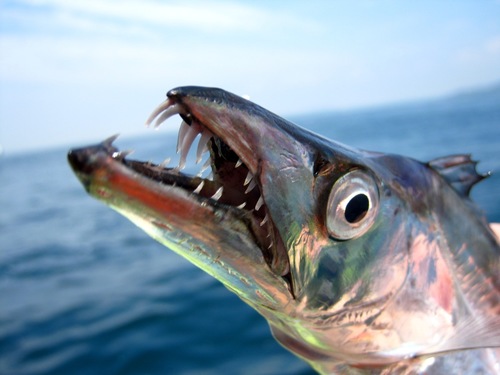
Largehead hairtails are silvery steel blue in color, turning silvery gray after death. The fins are generally semi-transparent and may have a yellowish tinge. Largehead hairtails are elongated in shape with a thin pointed tail (they lack a fish tail in the usual form). The eyes are large, and the large mouth contains long pointed fang-like teeth.

Largehead hairtails grow to 6 kg (10 lb) in weight, and 2.3 m (8 ft) in length. Most are only 0.5–1 m (2–3 ft) long, although they regularly reach 1.5–1.8 m (5–6 ft) in Australia.

Habitat

Largehead hairtails are found worldwide in tropical and temperate oceans. In the East Atlantic they range from southern United Kingdom to South Africa, including the Mediterranean Sea. In the West Atlantic it ranges from Virginia (occasionally Cape Cod) to northern Argentina, including the Caribbean Sea and Gulf of Mexico. In the East Pacific they range from southern California to Peru. Widespread in the Indo-Pacific region, ranging from the Red Sea to South Africa, Japan, the entire coast of Australia (except Tasmania and Victoria) and Fiji, they are absent from the central Pacific Ocean, including Hawaii. Some populations are migratory.

Behaviour

Juveniles participate in the diel vertical migration, rising to feed on krill and small fish during the night and returning to the sea bed in the day. This movement pattern is reversed by large adults, which mainly feed on fish. Other known prey items include squid and shrimp, and the highly carnivorous adults regularly cannibalise younger individuals. Largehead hairtails are often found in large, dense schools.

Humans & conservation

Largehead hairtail is a major commercial species. With reported landings of more than 1.3 million tonnes in 2009, it was the sixth most important captured fish species. The species is caught throughout much of its range, typically by bottom trawls or beach seines, but also using a wide range of other methods. In 2009, by far the largest catches (1.2 million tonnes) were reported by China and Taiwan from the Northwest Pacific (FAO Fishing Area 61). The next largest catches were reported from South Korea, Japan, and Pakistan. Some of the numerous other countries where regularly caught include Angola, Nigeria, Senegal, Mauritania, Morocco, Brazil, Trinidad, Colombia, Mexico, southeastern United States, Iran, India, and Australia.

Where to see it

No dive sites list Ribbonfish yet. Explore the map to find sites near you.