
← All marine life
Ribbon Eel
Species IUCN · Least Concern (LC)

Ribbon Eel

Rhinomuraena quaesita, Garman, 1888

marine

About Ribbon Eel

The ribbon eel (Rhinomuraena quaesita), also known as the leaf-nosed moray eel or bernis eel, is a species of moray eel, the only member of the genus Rhinomuraena. The ribbon eel is found in sand burrows and reefs in the Indo-Pacific Ocean. Although generally placed in the moray eel family Muraenidae, it has several distinctive features leading some to place it in its own family, Rhinomuraenidae.

Appearance

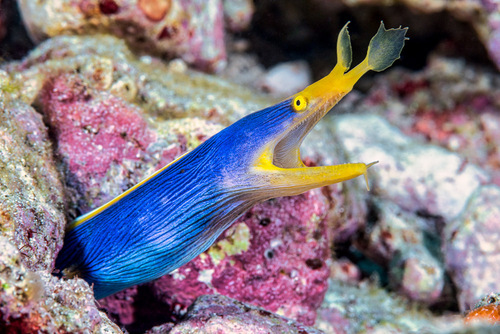
The species is characterized by its long, thin body and high dorsal fins. The ribbon eel can easily be recognized by its expanded anterior nostrils and wide-open jaws. These eels can have up to 255 vertebrae in their back bone, making them one of the most narrow and elongated eel species known.

In their juvenile and subadult stages, ribbon eels appear primarily jet black with a yellow dorsal fin. In adult males, the black is replaced by a vibrant blue and yellow facial appearance. An adult female is entirely yellow or yellow with some blue to the posterior.

Color change related to sex change is not known from any other moray eel species. The blue adult males range from 65 to 94 cm (26 to 37 in) in length, while the larger yellow females can reach up to 130 cm (51 in).

The ribbon eel larva is described as a large, greenish leptocephalus.
Habitat

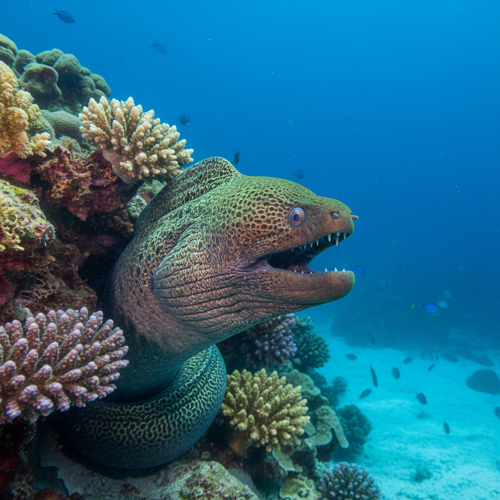
Typically, ribbon eels can be found in tropical parts of the Indian and Pacific Ocean, ranging from East Africa to southern Japan, Australia, and French Polynesia. This species is widely distributed and are seen by divers in Indonesian waters with their heads and anterior bodies protruding from crevices in sand and rubble habitats, like coral reefs, which they are able to slip through with their slime coat.

Ribbon eels prefer relatively shallow waters, frequenting a depth range of 1 to 57 meters.

Humans & conservation

Ribbon eels are labeled "least concerned" on the IUCN Red List of Threatened Species as of 2009. Recent studies on the effects of various environmental factors on marine eels have presented potential threats to the ribbon eel population. Marine eels that prefer to stay in shallower waters, specifically around coral reef habitats, are most at risk of suffering from the impacts of coral bleaching and other marine habitat damage caused by climate change or human activity (i.e. pollution). The shift in habitat structure and diversity could make it harder for ribbon eels to find enough prey to survive and reproduce. Overfishing is another concern as it can lead to a reduction in the number of ribbon eels and their available prey.

Part of

Where to see it

No dive sites list Ribbon Eel yet. Explore the map to find sites near you.