
← All marine life
Reeftop Pipefish
Species IUCN · Least Concern (LC)

Reeftop Pipefish

Corythoichthys haematopterus, (Bleeker, 1851)

marine

About Reeftop Pipefish

The messmate pipefish (Corythoichthys haematopterus) is a species of marine fish in the family Syngnathidae. It is widespread throughout the tropical waters of the Indo-Pacific region, from the eastern coast of Africa to the Vanuatu Islands. It occasionally makes its way into the aquarium trade where it is known as the dragonfaced pipefish.

Other common names are bloodspot pipefish, reef pipefish, reeftop pipefish and yellow-streaked pipefish.

The messmate pipefish exhibits biofluorescence, that is, when illuminated by blue or ultraviolet light, it re-emits it as yellow, and appears differently than under white light illumination. Biofluorescence may assist in intraspecific communication and camouflage. Messmate pipefish exhibit red fluorescent light strongly in the fins, which is important in signaling with conspecifics. These fluorescent pigments are found in cells similar to melanophores, which may originate from microorganisms.

Appearance

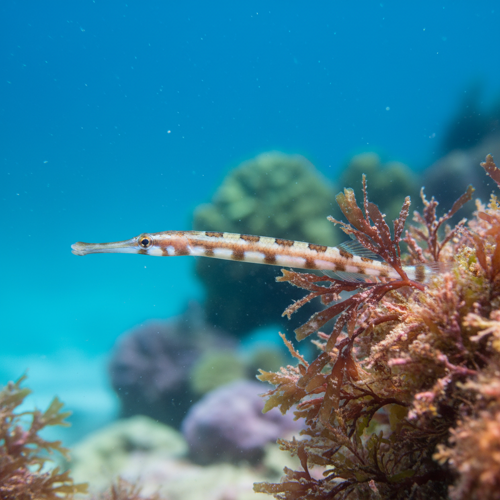
Messmate pipefish have an elongated body shape with a long and narrow snout, soft rayed dorsal fin, and caudal fin. Their length ranges between 9 cm to 18 cm as adults, with the average being 13 cm. Coloration is variable but the majority feature a pale body, striped or reticulate head, poorly defined brown horizontal stripes on the sides of its trunk and tail, and a dorsal fin without pale spots. The bands are generally less visible on females who also have dark splotches on the underside of their trunk rings at the anterior end. Males can have bright blue transverse bars on the ventral side of the anterior trunk. Located on the ventral side of males near the tail is the brood pouch. Instead of protective plates, the eggs are covered by fleshy folds.
Habitat

Messmate pipefish inhabit the Indo-Pacific region, the area that includes tropical waters from the Indian ocean to the Pacific ocean. Messmate pipefish can be found in shallow seawater around 0-19.8 meters deep and near the sandy bottom of reef, seagrass, and coral, and rocky habitats. Messmate pipefish cannot tolerate fluctuations in salinity and seem to prefer warm temperatures.

Population size and abundance are unknown for this species.

Behaviour

Messmate pipefish spend around 1 month in their pelagic larval form. Dispersal occurs during this stage and is largely dependent on ocean currents. Due to their long larval phase, messmate pipefish are able to disperse beyond geographic barriers, such as deep ocean straits, in contrast to other marine animals who have a larval phase that lasts only a few days to a week.

This species is cryptic and rarely swims into the water column other than to search for a mate. The more time individuals spend out in the open searching for mates or performing courting rituals, the higher the risk of predation by piscivorous fishes.

Reproduction

Messmate pipefish are strictly monogamous. They will mate with the same partner throughout the breeding season and will remain pairs until one dies or disappears. Despite being monogamous, females are the sex that primarily competes for mates which is in contrast to traditional sex roles where males invest more into mating and females provide majority of parental care. In these cases of sex role reversal, males are typically more choosy. The male’s brood pouch can only hold one clutch of eggs at a time, preventing it from successfully mating with more than one female. Occasionally males are observed carrying two clutches. However, the outer clutch is not able to adhere properly and always falls off by the next day. Females are unable to divide their clutches among different males.

Humans & conservation

Messmate pipefish are listed as Least Concern in the IUCN Red List. They may be affected by loss of coral and seagrass habitat but are able to survive in a variety of other habitats. Human activity like residential and commercial development, fishing, and pollution are possible reasons for habitat loss and fragmentation. Due to their sensitivity to and preferences in water temperature and salinity, they may be affected by climate change as well. During the Last Glacial Maximum when temperatures were around 50 °F colder than today, it is possible that some populations of messmate pipefish went extinct and only recolonized and expanded their range after temperatures increased. Messmate pipefish are kept in aquariums and can be bought online as pets. They may also be traded for use in traditional medicines like other Syngnathids but exact numbers are not known.

Part of

Where to see it

No dive sites list Reeftop Pipefish yet. Explore the map to find sites near you.