
← All marine life
Redhead Goby
Species IUCN · Least Concern (LC)

Redhead Goby

Elacatinus puncticulatus, (Ginsburg, 1938)

marine

About Redhead Goby

Elacatinus puncticulatus is a species of goby from the eastern central Pacific Ocean, where it is found on reefs from the Gulf of California to Ecuador. This species occurs at depths ranging from 1 to 21m, and usually in association with the sea urchin Eucidaris thouarsii. The size of the goby varies depending on sex, with females being typically smaller than males, and their geographical location as well as their role as a cleaner goby also has impacts on their morphology. Due to their bright coloration and lack of aggression, the species is commonly found in the aquarium trade.

Appearance

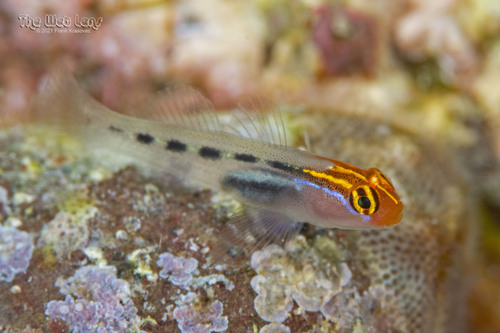
Elacatinus puncticulatus is a member of the family Gobiidae, which is broken up into two genera: Elacatinus and Gobiosoma. Elacatinus is a genus of goby fish comprising 25 species with characteristic 7 spines, 28 vertebrae, compressed skull shape, and transparent fins. E. puncticulatus are the only species in the genus that display a lack of scales on the head and body. The E. puncticulatus species in particular is characterized by the strong red and blue coloration on its head, with yellow and black striped coloration on its body, and a dark horizontal stripe behind its eye. The blue stripe near the head of many Elacatinus species is often seen as an adaptation that allows the fish to effectively attract clients that they clean as a part of their role as a symbiotic cleaner species.

Habitat

E. puncticulatus are a shallow-living goby found along the continental shore of the Tropical Eastern Pacific (TEP), which ranges from the Southern tip of the California peninsula to the South of Ecuador. Specifically within this area, the species live primarily between the subtidal zone and depths of 21m on rocky or coral reefs. Their habitat on coral reefs, considered "cleaning stations", which combined with the bright blue coloration on parts of their head allows the species to attract clients and feed off of the removed ectoparasites. They are the only species of the genus Elacatinus not found in the Atlantic, and only one of two species in the genus found in the TEP. Their distribution is shaped by habitat discontinuities that restrict their dispersal in the area, one of the most notable examples being two muddy sections of shore within the TEP.

Behaviour

Elacatinus puncticulatus are found in corals in the continental shelf of the TEP. They often live in association with sea urchins, although the reason for this is undetermined. The Elacatinus genus feeds primarily on ectoparasites from cleaning and cellular fish debris, and E. puncticulatus seem to be no different. Both males and females clean. Cleaning gobies can display cheating behavior when cleaning with a partner, where they consume scales and mucus from the clients instead of just ectoparasites, although this is uncommon in the Elacatinus genus. When cleaning with the opposite sex, males tend to modify behavior to be more cooperative and females tend to stay the same. Clients of this cleaning mutualism are either non-predatory fish like parrotfishes, or piscivorous fish that are potential predators for the goby, like longfin damselfish, yellowtail damselfish, and graysby grouper.

Reproduction

Elacatinus puncticulatus display active courtship before spawning and parental behaviors after spawning. Males of E. puncticulatus show a gray head and yellow and black body coloration instead of their usual red and blue head coloration. One day prior to spawning, males move their pectoral fins to promote burrow cleanliness and display heavy breathing to signify readiness. Females of E. puncticulatus display strong red and black colors, but become pale three days before spawning. The male knows the female is ready to spawn because her urogenital region turns from brown to red the day prior to spawning. The genus Elacatinus are primarily gonochoristic, do not change sex, and often maintain stable monogamous relationships throughout their life.

Where to see it

No dive sites list Redhead Goby yet. Explore the map to find sites near you.