
← All marine life
Red Tube Worm
Species

Red Tube Worm

Serpula vermicularis, Linnaeus, 1767

marine

About Red Tube Worm

Serpula vermicularis, known by common names including the calcareous tubeworm, fan worm, plume worm or red tube worm, is a species of segmented marine polychaete worm in the family Serpulidae. It is the type species of the genus Serpula and was first described by Carl Linnaeus in his 1767 12th edition of Systema Naturae. It lives in a tube into which it can retract.

Appearance

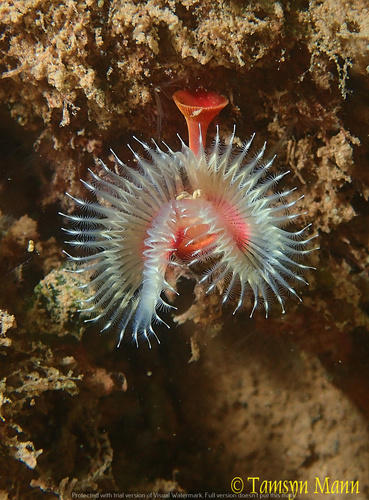
Serpula vermicularis lives in a calcareous tube which is attached to a rock, boulder or other hard surface. The tube is often curved, but is not tightly coiled as in some other related species. It can grow to a length of 20 cm (8 in), but is usually shorter than this. The anterior part of the worm protrudes from the tube and has a plume of about 40 feather-like radioles projecting from the second segment, or peristomium, which also houses the two eyes and the mouth. The radioles are bipinnate and covered with fine cilia. They are commonly red, orange or pink and are usually banded with white. A funnel-shaped lid or operculum covers the entrance to the tube when the animal retracts inside. This lid has up to 160 fine creases around its edge and is symmetrical and usually red. It is sometimes divided into two.

Habitat

Serpula vermicularis is cosmopolitan in distribution. It is found in the Pacific and Indian Oceans and the European seaboard of the Atlantic Ocean, but not on the North American coast. It occurs in the intertidal zone and at depths down to 100 m (330 ft). Also along Southern African coast from Olifant's River to Maputo.

Behaviour

Coldwater reefs built up by S. vermicularis take many years to develop and provide a hard substrate which other organisms use. The reefs around the United Kingdom support a diverse community of sessile invertebrates, including sponges, hydroids, ascidians, bryozoans, the worm Pomatoceros triqueter, the sea anemone Metridium senile and bivalves such as Chlamys spp., Modiolus modiolus and queen scallop, Aequipecten opercularis. Macrofauna include crabs such as Cancer pagurus, the sea urchins Echinus esculentus and Psammechinus miliaris, the brittle star Ophiothrix fragilis, the starfish Asterias rubens and the whelk Buccinum undatum. Red algae grow on the reef in shallow water. The tunicate Pyura microcosmus occurs on these reefs, but is seldom seen in other habitats. A large number of cryptic species of microfauna shelter among the tubes.

Reproduction

In the United Kingdom, spawning takes place between June and September. The larvae form part of the plankton for up to two months before settling on the seabed. Growth is fairly rapid with tubes extending by 1 centimetre (3⁄8 in) in a month. The worms mature in about 10 months and may live for several years.

Part of

Where to see it

No dive sites list Red Tube Worm yet. Explore the map to find sites near you.