← All marine life
Ram'S Horn Squid
Species IUCN · Least Concern (LC)

Ram'S Horn Squid

Spirula spirula, (Linnaeus, 1758)

marine

About Ram'S Horn Squid

Spirula spirula is a species of deep-water squid-like cephalopod mollusk. It is the only extant member of the genus Spirula, the family Spirulidae, and the order Spirulida. Because of the shape of its internal shell, it is commonly known as the ram's horn squid or the little post horn squid. Because the live animal has a light-emitting organ, it is also sometimes known as the tail-light squid.

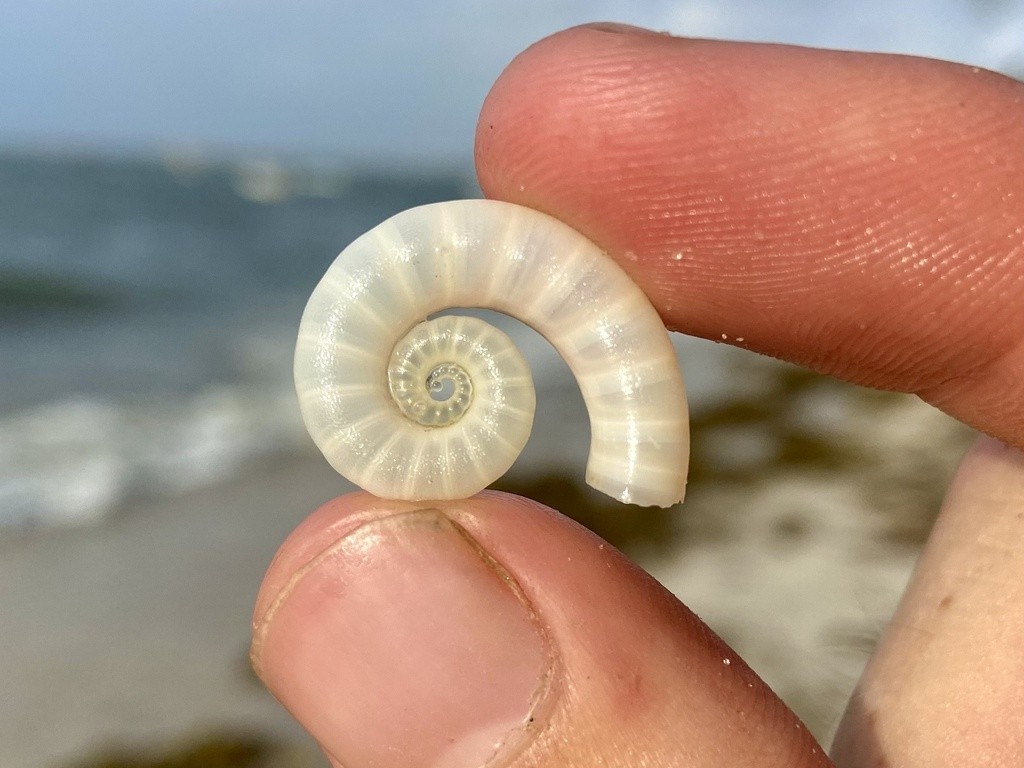
Live specimens of this cephalopod are very rarely seen because it is a deep-ocean dweller. The small internal shell of the species is, however, quite a familiar object to many beachcombers. The shell of Spirula is extremely light in weight, very buoyant, and surprisingly durable; it very commonly floats ashore onto tropical beaches (and sometimes even temperate beaches) all over the world. This seashell is known to shell collectors as the ram's horn shell or simply as Spirula.

Appearance

S. spirula has a squid-like body between 35 mm and 45 mm long. It is a decapod, with eight arms and two longer tentacles, all with suckers. The arms and tentacles can all be withdrawn completely into the mantle.

The species lacks a radula (or, at most, has a vestigial radula).

Habitat

By day, Spirula lives in the deep oceans, reaching depths of 1,000 m. At night, it rises to 100–300 m.

Its preferred temperature is around 10 °C, and it tends to live around oceanic islands, near the continental shelf.

Most sources cite this species as tropical and they are observed to be plentiful in the subtropical seas around the Canary Islands. Shells are regularly found along the western coasts of South Africa. In 2022, records of the species have also been confirmed in the Arabian Sea. However, significant quantities of shells from dead spirula are washed ashore even in temperate regions, such as coasts of New Zealand. Because of the great buoyancy of the shells, these may possibly have been carried long distances by ocean currents.

Behaviour

S. spirula is capable of emitting a green light from a photophore located at the tip of its mantle, between the ear-shaped fins.

Evidently this seems as a counter-illumination strategy, as in situ observations have captured footage of animals in a vertical stance, with photophore pointing downward and head up.

Where to see it

No dive sites list Ram'S Horn Squid yet. Explore the map to find sites near you.