
← All marine life
Quillback Rockfish
Species

Quillback Rockfish

Sebastes maliger, (Jordan & Gilbert, 1880)

marine

About Quillback Rockfish

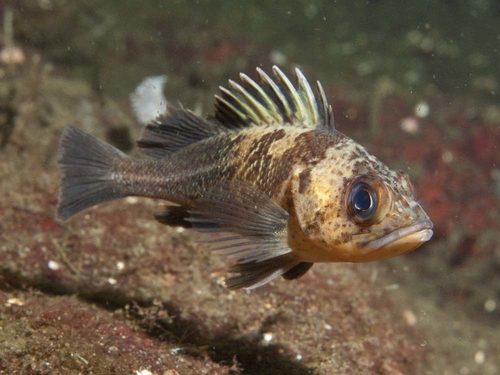
The quillback rockfish (Sebastes maliger), also known as the quillback seaperch, is a species of marine ray-finned fish belonging to the subfamily Sebastinae, the rockfishes, part of the family Scorpaenidae. This species primarily dwells in salt water reefs. The average adult weighs 2–7 pounds (0.9 – 3 kg) and may reach 1 m (3 feet) in length. Quillback rockfish are named for the sharp, venomous quills or spines on the dorsal fin. Their mottled orange-brown coloring allows them to blend in with rocky bottom reefs. The quillback rockfish eats mainly crustaceans, but will also eat herring. They are solitary and minimally migratory, but not territorial, and give birth to live young (viviparous). They are a popular sport fish, generally caught in cold water 41–60 m deep, but also to subtidal depths of 275 m.

Appearance

The quillback rockfish has a maximum recorded total length of 61 cm (24 in) and weight of 3.3 kg (7.3 lb).

The quillback rockfish have a head protected by strong spines, the nasal, preocular, postocular, tympanic and parietal spines are present while there are no supraocular, coronal and nuchal spines. There are 13 spines and between 12 and 14 soft rays in the dorsal fin with the anal fin having 3 spines and 6 or 7 soft rays. The spines in the dorsal fin are very long and the membranes between the spines are deeply incised.
Habitat

The quillback rockfish lives along the Pacific coast from the Gulf of Alaska to the northern Channel Islands of Southern California. Like other rockfish species, quillbacks live on the bottom, perching on rocks or hiding in rock crevices.

The juveniles stay mainly along the shore, in reefs, sand and eelgrass, while the adult rockfish live in the deeper waters. They are for the most part solitary dwellers, rarely being found in groups. They are rarely found in the open ocean, generally preferring to stay close to kelp, rocks, coral, or lodged in crevices or holes. Despite this, they are not territorial. High densities tend to coincide with peak plant growth. They occupy a variety of habitats in many different areas on the west coast of North America.

Part of

Where to see it

No dive sites list Quillback Rockfish yet. Explore the map to find sites near you.