
← All marine life
Queensland Seahorse
Species IUCN · Vulnerable (VU)

Queensland Seahorse

Hippocampus spinosissimus, Weber, 1913

marinebrackish

About Queensland Seahorse

The hedgehog seahorse (Hippocampus spinosissimus) is a species of fish of the family Syngnathidae. It inhabits coastal waters from India and Sri Lanka to Taiwan and northern Australia. It is threatened by overfishing, as both targeted catch and bycatch. This species is ovoviviparous, with males carrying eggs in a brood pouch before giving birth to live young.

Appearance

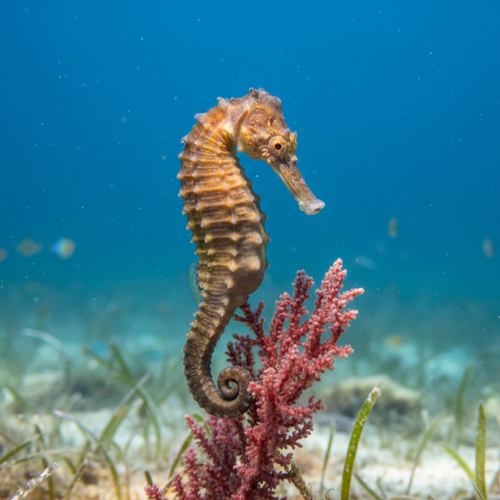
Hippocampus spinosissimus is usually around 12.5 centimetres (4.9 in) long, with a long snout and a low coronet. Spines vary through life, with juveniles being more spiny than adults. Individuals usually have a yellow-orange to deep red or dark brown snout, a dark front of head, and pale grey saddles or bands over the trunk and tail. Deepwater specimens are usually red or orange, likely to match the sponges and corals at that depth.
Habitat

Hippocampus spinosissimus inhabits reef systems, occupying sand or silt bottoms, to a maximum depth of 70 metres (230 ft). In the central Philippines, individuals are most commonly found on relatively barren soft or sandy bottoms and depressions, where they associate with octocorals, sea stars, sea pens, sea urchins, sponges, submerged wood and macroalgae. They are rarely found in direct association with reefs or hard corals. Trawls in Malaysia indicate similar habitat choice.

Behaviour

This species is carnivorous, feeding on small crustaceans such as copepods, amphipods, and gammarid, caprellid, and caridean shrimps, as well as other planktonic invertebrates.

Reproduction

Hippocampus spinosissimus is an ovoviviparous species, with the female using an ovipositor to transfer eggs to an enclosed brood pouch on the male's stomach. The male then fertilizes and protects the developing embryos before giving birth to tiny (5.63 millimetres (0.222 in)) independent young. Individuals reach sexual maturity when they are around 10.4 centimetres (4.1 in).

Humans & conservation

The major threat to H. spinosissimus is overfishing. It is caught as bycatch in many artisanal and commercial fisheries throughout its range, such as in Cambodia, Malaysia, Thailand, the Philippines and Vietnam. This species is one of the two most heavily reported species in trade - an indicator of the high levels of exploitation pressure from bycatch that is exerted on it.

Part of

Where to see it

No dive sites list Queensland Seahorse yet. Explore the map to find sites near you.